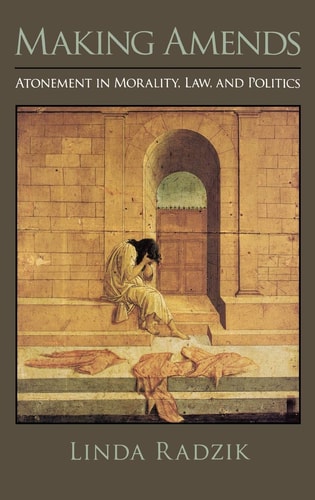
Making Amends: Atonement in Morality, Law, and Politics
0
0
As an Amazon Associate and affiliate partner, Menrva Books earns from qualifying purchases. Learn more
Author Description
Can wrongs be righted? Can we make up for our misdeeds, or does the impossibility of changing the past mean that we remain permanently guilty? While atonement is traditionally considered a theological topic, Making Amends uses the resources of secular moral philosophy to explore the possibility of correcting the wrongs we do to one another.Philosophers generally approach the problem of past wrongdoing from the point of view of either a judge or a victim. They assume that wrongdoing can only be resolved through punishment or forgiveness. But this book explores the responses that wrongdoers can and should make to their own misdeeds, responses such as apology, repentance, reparations, and self-punishment. Making Amends explores the possibility of atonement in a broad spectrum of contexts--from cases of relatively minor wrongs in personal relationships, to crimes, to the historical injustices of our political and religious communities. It argues that wrongdoers often have the ability to earn redemption within the moral community.Making Amends defends a theory of atonement that emphasizes the rebuilding of respect and trust among victims, communities and wrongdoers. The ideal of reconciliation enables us to explain the value of repentance without restricting our interest to the wrongdoer's character, to account for the power of reparations without placing a dollar value on dignity, to justify the suffering of guilt without falling into a simplistic endorsement of retribution, and to insist on the moral responsibility of wrongdoing groups without treating their members unfairly.
Menrva's Summary
THE THESIS
Can individuals and communities effectively rectify past moral failures through secular processes of atonement? Linda Radzik, a scholar of moral philosophy, investigates the mechanisms of apology, reparation, and repentance outside of traditional theological frameworks. She argues that wrongdoers possess the capacity to earn redemption by actively rebuilding trust and respect within their moral communities, moving beyond the binary of simple punishment or forgiveness.
THE SCOPE MAP
What You Will Find
- A philosophical framework for secular atonement and moral responsibility.
- Analysis of restorative responses including apology, repentance, and reparations.
- Examination of wrongdoing across personal, criminal, and historical political contexts.
- A critique of traditional retributive justice models in favor of reconciliation.
THE AUTHORITY PERSPECTIVE
Scholars and ethicists frequently cite this work as a significant contribution to the discourse on restorative justice and moral philosophy. Readers often note the clarity with which Radzik navigates complex intersections between individual accountability and collective political responsibility.
Page Count:
256
Publication Date:
2009-02-02
Publisher:
Oxford University Press
ISBN-10:
0195373669
ISBN-13:
9780195373660
Philosophy
Reconciliation
Restitution
Ethics
Law
Social Issues
Atonement
Responsibility
Community Tags
Other Editions(2)

Similar Books