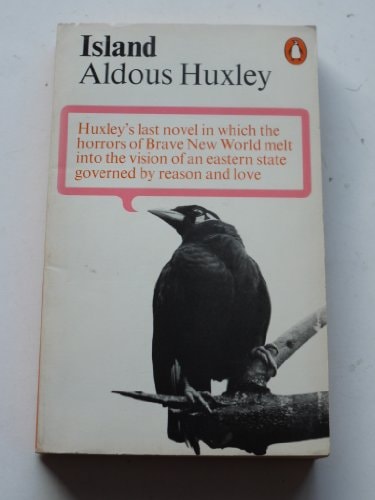
Island
0
0
As an Amazon Associate and affiliate partner, Menrva Books earns from qualifying purchases. Learn more
Author Description
In his final novel, which he considered his most important, Aldous Huxley transports us to the remote Pacific island of Pala, where an ideal society has flourished for 120 years.Inevitably, this island of bliss attracts the envy and enmity of the surrounding world. A conspiracy is underway to take over Pala, and events are set in motion when an agent of the conspirators, a newspaperman named Faranby, is shipwrecked there. What Faranby doesn't expect is how his time with the people of Pala will revolutionize all his values and—to his amazement—give him hope.
Menrva's Summary
THE PULSE
When a cynical journalist is shipwrecked on the isolated island of Pala, he discovers a society built on principles of freedom and enlightenment that stands in direct opposition to his own world. Will Faranby arrives on the island as an agent for a corporate entity intent on exploiting Pala's resources, but he finds himself confronted by a culture that integrates Eastern philosophy, Western science, and psychedelic exploration. As the threat of a coup d'état looms, Faranby must navigate the tension between his original mission and the profound ideological shift he experiences. The narrative utilizes a blend of dialogue-heavy philosophical inquiry and traditional prose to examine the feasibility of a functional utopia.
INSIDE THE PAGES
- Detailed exploration of utopian social structures
- Integration of Eastern and Western philosophical traditions
- Use of fictional psychoactive substances as tools for self-discovery
- Critique of industrialization and modern materialism
- Focus on educational reform and child-rearing practices
- Examination of political corruption and external imperialism
- Extensive use of Socratic dialogue to convey ideological concepts
- Contrast between the protagonist's cynicism and the islanders' openness
THE COLLECTIVE ECHO
Readers and critics often describe this work as a dense, didactic counterpoint to the author's earlier dystopian writing. Discussion frequently centers on the balance between the book's heavy philosophical exposition and its narrative progression, with some noting that the plot serves primarily as a vehicle for the author's social theories. Many highlight the effectiveness of the world-building in creating a plausible alternative to modern society, though others argue that the characters function more as mouthpieces for ideas than as fully realized individuals. The text remains a significant point of interest for those examining the intersection of literature and social engineering.
Page Count:
304
Publication Date:
1970-07-30
Publisher:
Penguin Books Ltd
ISBN-10:
0140021930
ISBN-13:
9780140021936
Satire
Literary
Utopian
classic
Classics
Political fiction
Irish fiction
Philosophical