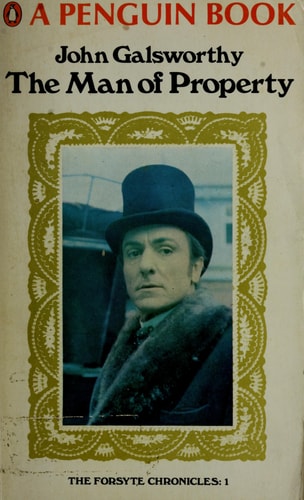
A Man of Property
0
0
As an Amazon Associate and affiliate partner, Menrva Books earns from qualifying purchases. Learn more
Author Description
This historic book may have numerous typos and missing text. Purchasers can download a free scanned copy of the original book (without typos) from the publisher. Not indexed. Not illustrated. 1906 edition....the beast, the greater the fascination. But whether because the spectators envied his appetite, or, more humanely, because it was so soon to be satisfied, young Jolyon could not tell. Remarks kept falling on his ' That's a nasty-looking brute, that tiger!" "Oh, what a love! Look at his little mouth!" "Yes, he's rather nice! Don't go too near, mother." And frequently, with little pats, one or another would clap their hands to their pockets behind and look round, as though expecting young Jolyon or some disinterested-looking person to relieve them of the contents. A well-fed man in a white waistcoat said slowly through his " It's all greed; they can't be hungry. Why, they take no exercise." At these words a tiger snatched a piece of bleeding liver, and the fat man laughed. His wife, in a Paris-model frock and gold nose-nippers, reproved "How can you laugh, Harry? Such a horrid sight!" Young Jolyon frowned. The circumstances of his life, though he had ceased to take a too personal view of them, had left him subject to an intermittent contempt; and the class to which he had belonged--the carriage class--especially excited his sarcasm. To shut up a lion or tiger in confinement was surely a horrible barbarity. But no cultivated person would admit this. The idea of its being barbarous to confine wild animals had probably never occurred to his father for instance; he belonged to the old school, who considered it at once humanising and educational to confine baboons and panthers, holding the view, no doubt, that in course of time they might induce these creatures not so unreasonably to die of misery and heart-sickness against the bars of their cages, and put the society to the expense of getting others! In his eyes, as in the eyes of all...
Menrva's Summary
THE PULSE
The arrival of an outsider into the rigid, wealth-obsessed Forsyte family triggers a series of social and moral fractures that threaten their carefully constructed status. Soames Forsyte, a man defined by his possessive nature and adherence to Victorian social codes, attempts to secure his standing by marrying Irene, a woman who does not return his affections. The narrative examines the tension between the accumulation of material property and the human desire for autonomy. Through a third-person omniscient perspective, the text exposes the logical constraints of a class-bound society where human beings are often treated as assets to be owned or displayed.
INSIDE THE PAGES
- Detailed examination of the upper-middle-class Victorian social hierarchy
- Exploration of the concept of marriage as a property transaction
- Use of irony to critique the materialism of the Forsyte family
- Contrast between the 'carriage class' and the individual spirit
- Focus on the psychological rigidity of the protagonist
- Atmospheric depiction of London social life at the turn of the century
- Intergenerational conflict within the extended Forsyte family
- Emphasis on the tension between tradition and personal freedom
THE COLLECTIVE ECHO
Readers frequently highlight the clinical precision with which Galsworthy dissects the manners and motivations of the British upper-middle class. Discussion often centers on the character of Soames Forsyte, who serves as a polarizing figure representing both the stability and the suffocating nature of his social stratum. Critics often point to the pacing as deliberate and methodical, reflecting the slow, inevitable decay of the values the characters hold dear. The work is widely recognized for its ability to balance intimate character studies with a broader critique of late Victorian materialism. Readers often note that the narrative provides a window into a specific historical moment where the acquisition of wealth was synonymous with moral character.
Page Count:
0
Publication Date:
1977-09-29
Publisher:
Penguin Books
ISBN-10:
0140031960
ISBN-13:
9780140031966
Historical Fiction
Social Satire
Family Saga
Victorian Era
Classic Literature
Community Tags
Similar Books