
Framley Parsonage
0
0
As an Amazon Associate and affiliate partner, Menrva Books earns from qualifying purchases. Learn more
Author Description
'The fact is, Mark, that you and I cannot conceive the depth of fraud in such a man as that.' The Reverend Mark Robarts makes a mistake. Drawn into a social set at odds with his clerical responsibilities, he guarantees the debts of an unscrupulous Member of Parliament. He stands to lose his reputation, and his family, future, and home are all in peril. His patroness, the proud and demanding Lady Lufton, is offended and the romantic hopes of Mark's sister Lucy, courted by Lady Lufton's son, are in jeopardy. Pride and ambition are set against love and integrity in a novel that has remained one of Trollope's most popular stories. Set against ecclesiastical events in the Barchester diocese and informed by British political instability after the Crimean War, Trollope's fourth Barchester novel was his first major success. A compelling history of uncertain futures, Framley Parsonage is a vivid exploration of emotional and geographical displacement that grew out of Trollope's own experiences as he returned to England from Ireland in 1859.
Menrva's Summary
THE PULSE
The Reverend Mark Robarts jeopardizes his clerical standing and family security when he unwisely guarantees the debts of a deceitful Member of Parliament. Driven by social ambition and a desire to integrate into a higher circle, Robarts finds himself entangled in financial ruin that threatens his position at Framley Parsonage. His actions alienate his influential patroness, Lady Lufton, and complicate the romantic prospects of his sister, Lucy, who faces opposition due to her brother's compromised reputation. The narrative unfolds through a third-person perspective that observes the intersection of ecclesiastical duty, political maneuvering, and personal integrity within the Barchester diocese.
INSIDE THE PAGES
- Examination of Victorian social hierarchy and class mobility
- Exploration of the tension between personal ambition and professional duty
- Detailed depiction of clerical life in the mid-19th century
- Interweaving of romantic subplots with financial and political crises
- Use of irony to critique the behavior of the landed gentry
- Focus on the moral development of the protagonist
- Integration of historical context regarding post-Crimean War British politics
- Character-driven narrative focusing on reputation and social standing
THE COLLECTIVE ECHO
Readers and critics frequently highlight the novel's keen observation of Victorian social mores and the nuanced portrayal of its characters. Discussion often centers on the effectiveness of Trollope's pacing, which balances domestic concerns with broader societal shifts in the Barchester diocese. Many appreciate the author's ability to render the internal conflicts of the clergy with both humor and gravity. The work is often cited for its accessibility and its role in establishing the author's reputation as a chronicler of his era. Readers frequently note that the themes of integrity and pride remain relevant, providing a clear window into the social pressures of the period.
Page Count:
528
Publication Date:
2014-01-01
Publisher:
Oup Oxford
ISBN-10:
0191640034
ISBN-13:
9780191640032
Historical Fiction
Domestic fiction
Genre Fiction
Victorian
Social Satire
Classic Literature
Family Saga
Community Tags
Other Editions(42)
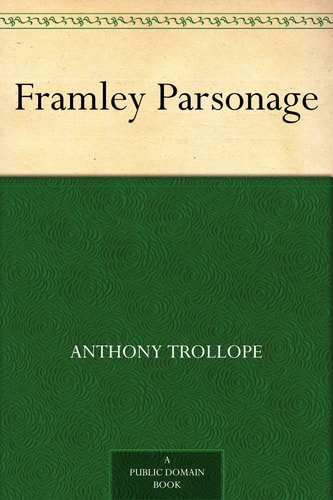
Creative Media Partners, LLC
2025
Default edition
BoD - Books on Demand
2023

IndoEuropeanPublishing.com
2023

Creative Media Partners, LLC
2022

Independently Published
2021
Independently Published
2020

Independently Published
2020
Independently Published
2020

Independently Published
2020

Amazon Digital Services LLC - KDP Print US
2019

Independently Published
2019
Independently Published
2019

Independently Published
2019
Independently Published
2019

HardPress
2019

Independently Published
2019

Amazon Digital Services LLC - KDP Print US
2019
Amazon Digital Services LLC - KDP Print US
2019

CreateSpace Independent Publishing Platform
2018
Creative Media Partners, LLC
2018

CreateSpace Independent Publishing Platform
2018

CreateSpace Independent Publishing Platform
2018
Max Bollinger
2018
CreateSpace Independent Publishing Platform
2018

CreateSpace Independent Publishing Platform
2017

CreateSpace Independent Publishing Platform
2017

CreateSpace Independent Publishing Platform
2017

CreateSpace Independent Publishing Platform
2017

CreateSpace Independent Publishing Platform
2015

Oxford University Press
2014

Literary Licensing, LLC
2014
Oup Oxford
2014

OUP Oxford
2014

CreateSpace Independent Publishing Platform
2013

CreateSpace Independent Publishing Platform
2012

EBooksLib
2005

eBooksLib
2005

NuVision Publications
2004

Books On Tape
1996

Oxford University Press
1989
Oxford University Press
1981

Zodiac Press
1980
Similar Books

Reader Comments
Share Your Thoughts
No comments yet. Be the first to share your thoughts!