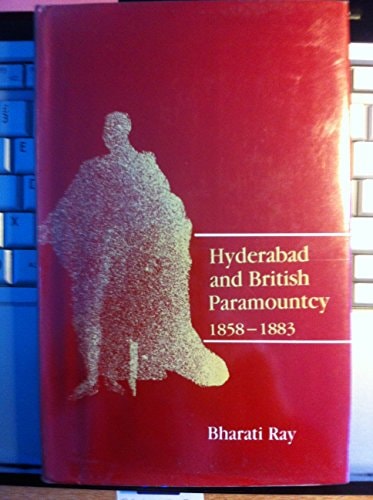
Hyderabad and British Paramountcy 1858-1883
0
0
As an Amazon Associate and affiliate partner, Menrva Books earns from qualifying purchases. Learn more
Author Description
The princely states constituted an integral part of the empire of Britain in India. Not formally annexed, they were controlled by the British through the doctrine of paramountcy. Professor Ray analyses how pressure-groups as well as official circles in Britain shaped this doctrine and wielded it as an instrument of exploitation. The book is a commentary on the legal, political, administrative and economic implications of the application of the policy of paramountcy to Hyderabad in the later half of the nineteenth century. It is also an eminently readable account of the aims and stratagems of Sir Salar Jung who was simultaneously the principle collaborator and chief adversary of British power.
Menrva's Summary
THE THESIS
This work investigates the mechanisms of British paramountcy and its specific application to the princely state of Hyderabad during the late nineteenth century. Professor Bharati Ray, an established historian, utilizes colonial administrative records and private papers to examine the intersection of British imperial policy and local governance. The text argues that the doctrine of paramountcy functioned as a sophisticated instrument of economic and political control, rather than a mere administrative formality, and highlights the complex role of Sir Salar Jung as both a collaborator and a resistor of British influence.
THE SCOPE MAP
What You Will Find
- Analysis of the legal and administrative frameworks of British paramountcy in India.
- Detailed examination of the political and economic exploitation of Hyderabad between 1858 and 1883.
- Biographical assessment of Sir Salar Jung and his strategic maneuvers against British power.
- Evaluation of pressure groups and official circles in Britain that influenced colonial policy.
THE AUTHORITY PERSPECTIVE
Scholars recognize this text as a significant contribution to the study of princely states within the British Indian Empire. Readers frequently note the academic density of the prose and the meticulous use of primary source documentation to support the author's arguments.
Page Count:
268
Publication Date:
1989-01-26
Publisher:
Oxford University Press
ISBN-10:
0195622316
ISBN-13:
9780195622317
History
India
Colonialism
British asia
Asian History
Community Tags
Similar Books