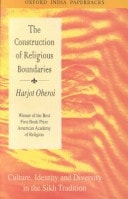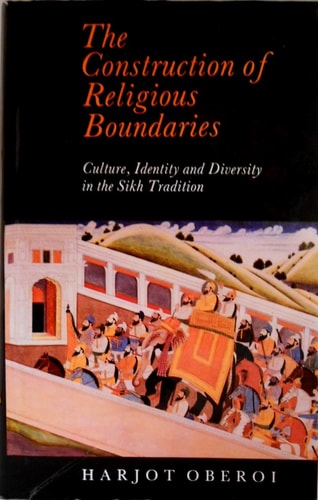
The Construction of Religious Boundaries: Culture, Identity and Diversity in the Sikh Tradition
0
0
As an Amazon Associate and affiliate partner, Menrva Books earns from qualifying purchases. Learn more
Author Description
This study lays the foundation for a major reinterpretation of religion and society in India. By extensively using post-structuralist theory, Oberoi suggests an alternative to earlier scholarly narratives that saw Sikhism, Hindism, and Islam as historically given categories encompassingwell-demarcated and self-conscious units of religious identity. The theoretical advances are made through a searching examination of Sikh historical materials.
Menrva's Summary
THE THESIS
This work investigates the historical construction of religious identities in India, challenging the assumption that Sikhism, Hinduism, and Islam have always existed as monolithic, self-contained categories. Harjot Oberoi, a professor of Sikh Studies at the University of British Columbia, utilizes post-structuralist theory to deconstruct traditional historiography. By examining Sikh historical materials, he argues that religious boundaries were fluid and porous, shaped by cultural shifts rather than static, ancient definitions.
THE SCOPE MAP
What You Will Find
- A critical analysis of Sikh historical texts and cultural practices.
- Application of post-structuralist theoretical frameworks to religious studies.
- Examination of the transition from pluralistic religious identities to rigid communal boundaries.
- A reinterpretation of the socio-religious landscape in pre-colonial and colonial India.
THE AUTHORITY PERSPECTIVE
Scholars frequently cite this text as a foundational contribution to the study of religious identity and the critique of colonial-era categorization in South Asia. Readers often note the academic density of the prose, which requires a strong background in historical theory to fully appreciate the author's arguments.
Page Count:
516
Publication Date:
2099-11-30
Publisher:
Oxford University Press
ISBN-10:
0195632885
ISBN-13:
9780195632880
History
Religion
Sociology
India
Sikhism