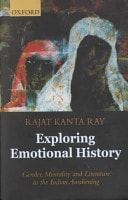
Exploring Emotional History: Gender, Mentality, and Literature in the Indian Awakening
0
0
As an Amazon Associate and affiliate partner, Menrva Books earns from qualifying purchases. Learn more
Author Description
This book draws on a new interdisciplinary field known as emotional history, which combines insights and techniques from psychology, history, and gender studies. The book sheds new light on the Bengal Renaissance and the Indian Awakening by showing how the gender structure of Indian society, especially the predominance of caste and community, shaped the Indian experience of love in the nineteenth and twentieth centuries. The unique quality of this experience derived from the persistence of caste despite the rise of a new romantic mentality. The author describes the rich emotional histories that resulted and reveals how these experiences have contributed to the restructuring of the culture over the last two centuries.
Menrva's Summary
THE THESIS
This book investigates how the intersection of caste, community, and gender structures shaped the evolution of romantic sentiment and emotional experience during the Indian Awakening. Rajat Kanta Ray, a distinguished historian of modern India, utilizes an interdisciplinary framework to synthesize psychological theory with historical analysis. By examining the Bengal Renaissance, the author argues that the persistence of traditional social hierarchies fundamentally altered the development of modern romantic mentalities in India over the last two centuries.
THE SCOPE MAP
What You Will Find
- Analysis of the Bengal Renaissance and its impact on social structures.
- Application of emotional history as a methodology for interpreting cultural shifts.
- Examination of the tension between caste-based social organization and emerging romantic ideals.
- Historical inquiry into the evolution of gender roles and interpersonal relationships in nineteenth and twentieth-century India.
THE AUTHORITY PERSPECTIVE
Scholars recognize this work as a significant contribution to the study of social history and the emotional dimensions of the Indian Awakening. Readers frequently note the academic density of the prose and the author's nuanced approach to integrating psychology with historical narrative.
Page Count:
348
Publication Date:
2001-08-16
Publisher:
Oxford University Press
ISBN-10:
0195652924
ISBN-13:
9780195652925
Psychology
History
Gender Studies
India - History
Social History
Indian History
Community Tags
Similar Books