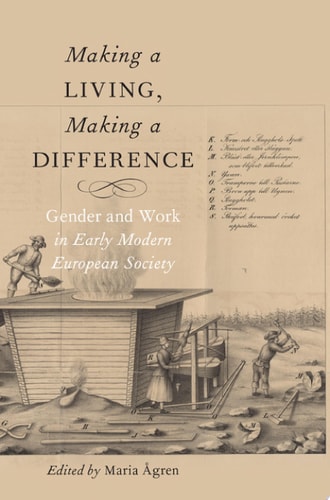
Making a Living, Making a Difference: Gender and Work in Early Modern European Society
0
0
As an Amazon Associate and affiliate partner, Menrva Books earns from qualifying purchases. Learn more
Author Description
What do people do all day? What did women and men do to make a living in early modern Europe, and what did their work mean? As this book shows, the meanings depended both on the worker and on the context.With an innovative analytic method that is yoked to a specially-built database of source materials, this book revises many received opinions about the history of gender and work in Europe. The applied verb-oriented method finds the 'work verbs' that appear incidentally in a wide variety of early modern sources and then analyzes the context in which they appear. By tying information technologies and computer-assisted analysis to the analytic powers--both quantitative and qualitative--of professional historians, the method gets much closer to a participatory observation of the micro-patterns of early modern life than was once believed possible.This book directly addresses a number of broad problems often debated by historians of gender and early modern Europe. First, it discusses the problem of assessing more accurately the incidence, character and division of work. Second, it analyzes the configurations of work and human difference. Third, it deals with the extent to which work practices created notions of difference--gender difference but also other forms of difference--and, conversely, to what extent work practices contributed to notions of sameness and gender convergence. Finally, it studies the impact of processes of change. Drawing on sources from Sweden, the authors show the importance of multiple employment, the openness of early modern households, the significance of marriage and marital status, the gendered nature of specific tasks, and the ways in which state formation and commercialization were entangled in people's everyday lives.
Menrva's Summary
THE THESIS
This book investigates how gender and social context shaped the nature and meaning of work in early modern European society. Maria Ågren, a professor of history, utilizes a novel verb-oriented methodology to analyze incidental mentions of labor in historical records. By integrating computer-assisted database analysis with traditional historical inquiry, the author challenges established narratives regarding the division of labor and the construction of gender roles in pre-industrial Sweden and Europe.
THE SCOPE MAP
What You Will Find
- A verb-oriented analytical framework for identifying labor patterns in historical documents.
- Quantitative and qualitative analysis of early modern employment practices.
- Examination of the intersection between state formation, commercialization, and household labor.
Scope Limits
- The primary empirical data is focused on Swedish historical sources.
- The study does not provide a comprehensive survey of all European regions, focusing instead on specific micro-patterns.
THE AUTHORITY PERSPECTIVE
Scholars recognize this work as a methodological advancement in the field of social history, particularly for its innovative use of digital humanities tools to parse archival data. Experts frequently highlight the book as a significant contribution to the ongoing debate regarding gendered labor divisions and the fluidity of work roles in the early modern period.
Page Count:
272
Publication Date:
2016-01-01
Publisher:
Oxford University Press
ISBN-10:
0190240644
ISBN-13:
9780190240646
History
Gender Studies
European History
Sociology
Early Modern
Labor history
Social History
Community Tags
Similar Books