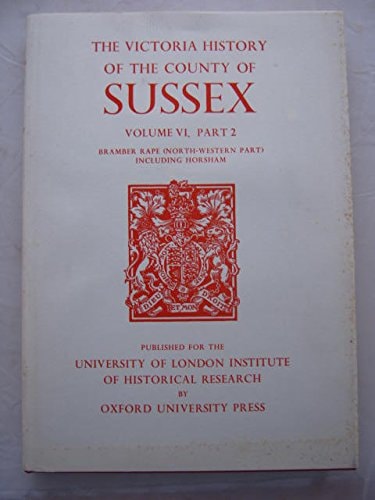
A History of the County of Sussex: Volume 6, Bramber Rape (North-Western Part) Including Horsham, Part 2
0
0
As an Amazon Associate and affiliate partner, Menrva Books earns from qualifying purchases. Learn more
Author Description
The volume gives the history of the ten parishes that form the north-western part of Bramber rape, from Sullington in the south to Warnharn in the north, lying mostly in the Weald. Horsham is the focus of the area, and its historyoccupies more than a third of the volume. It was a borough by 1235 and developed later as one of the chief towns of the county, hav-ing the county gaol from the 16th to the 19th century and being from 1889 to 1916 joint county town of West Sussex with Chichester. Horsham parish also contained an extensive rural area, and West Grin-stead and Shipley were other unusually large parishes. The land was heavily wooded in the Middle Ages and settlement was scattered; many settlements originated as outlying holdings of manors centred in the south end of the rape. Later, some settlements grew as ribbons along main roads, others around the edges of commons. From the mid 19th century there was an influx of wealthy residents: among the new- comers was Hilaire Belloc, and the large houses built or rebuilt included Warnham Court, seat of the Lucases, and Little Thakeham, designed by Lutyens. Humbler houses in considerable numbers were built at Ashington, Barns Green, Partridge Green, Sullington, and Thakeham, and Horsham more than trebled in size between 1891 and 1971. Agriculture was limited by the extensive woodland; open fields were few and small, and there were many parks and commons. To provide for London and the coastal towns stock raising and dairying came to predominate over arable from c.1850, and was accompanied by poultry farming and market gardening. The mainindustrial activities have been ironworking and brickmaking.
Menrva's Summary
THE THESIS
This volume investigates the historical development, land use, and socio-economic evolution of the north-western part of the Bramber rape in Sussex. T. P. Hudson, an expert contributor to the Victoria County History project, utilizes extensive archival research and primary source documentation to chronicle the transformation of ten specific parishes. The text provides a rigorous framework for understanding how rural settlements, agricultural shifts, and industrial activities shaped this region from the medieval period through the late 20th century.
THE SCOPE MAP
What You Will Find
- Detailed historical accounts of ten parishes including Horsham, Sullington, and Warnham.
- Analysis of settlement patterns ranging from medieval manorial holdings to 19th-century ribbon development.
- Documentation of economic transitions from woodland agriculture to stock raising, dairying, and market gardening.
- Records of industrial history focusing on local ironworking and brickmaking sectors.
THE AUTHORITY PERSPECTIVE
Experts and historians regard this volume as a foundational reference for the regional history of West Sussex. Readers frequently note the academic density of the prose and the meticulous attention to administrative and topographical detail provided by the Victoria County History series.
Page Count:
277
Publication Date:
1986-01-01
Publisher:
Victoria County History
ISBN-10:
0197227678
ISBN-13:
9780197227671
History
Geography
United Kingdom
Local History
Reference
Great Britain
Community Tags
Similar Books