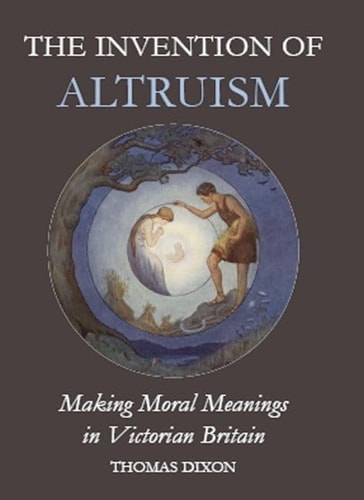
The Invention of Altruism: Making Moral Meanings in Victorian Britain
0
0
As an Amazon Associate and affiliate partner, Menrva Books earns from qualifying purchases. Learn more
Author Description
"Altruism" was coined by the French sociologist Auguste Comte in the early 1850s as a theoretical term in his 'cerebral theory' and as the central ideal of his atheistic "Religion of Humanity." In The Invention of Altruism, Thomas Dixon traces this new language of 'altruism' as it spread through British culture between the 1850s and the 1900s, and in doing so provides a new portrait of Victorian moral thought.Drawing attention to the importance of Comtean positivism in setting the agenda for debates about science and religion, this volume challenges received ideas about both Charles Darwin and Herbert Spencer as moral philosophers. Darwin saw sympathy and love, not only selfishness and competition, throughout the natural world. Spencer was the instigator of an Anti-Aggression League and an advocate of greater altruism in Britain's dealings with the "lower races." It also sheds light on the rise of popular socialism in the 1880s, on the creation of the idealist 'altruist' in novels of the 1890s, and on the individualistic philosophies of Friedrich Nietzsche, Oscar Wilde, and G. E. Moore--authors considered by some to be representative of fin de siècle "egomania."This wide-ranging study in the history of ideas is highly relevant to contemporary debates about altruism, evolution, religion, and ethics.
Menrva's Summary
THE THESIS
This work investigates the origins and cultural dissemination of the term 'altruism' within Victorian Britain to determine how it reshaped moral discourse. Thomas Dixon, a historian of ideas, utilizes a rigorous analysis of intellectual history to examine how Auguste Comte's sociological concept permeated British thought. By synthesizing primary texts from philosophers, scientists, and novelists, the author argues that the adoption of this term fundamentally altered the Victorian understanding of human nature, ethics, and social responsibility.
THE SCOPE MAP
What You Will Find
- An analysis of the intellectual transition from Comtean positivism to broader British moral philosophy.
- Re-evaluations of the moral frameworks proposed by Charles Darwin and Herbert Spencer.
- Historical documentation of the term's influence on late 19th-century socialism and literary idealism.
- A comparative study of individualistic philosophies held by figures such as Friedrich Nietzsche and Oscar Wilde.
THE AUTHORITY PERSPECTIVE
Scholars recognize this text as a significant contribution to the history of ideas, particularly for its nuanced treatment of Victorian moral vocabulary. Readers frequently note the academic density of the prose, which provides a comprehensive framework for understanding the evolution of ethical terminology.
Page Count:
440
Publication Date:
2008-07-15
Publisher:
British Academy
ISBN-10:
0197264263
ISBN-13:
9780197264263
Religion
Philosophy
History
Sociology
Altruism
Ethics
Ethics history
Community Tags
Similar Books