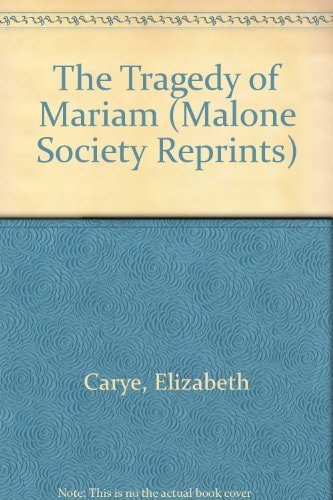
The Tragedy of Mariam
0
0
As an Amazon Associate and affiliate partner, Menrva Books earns from qualifying purchases. Learn more
Author Description
Originally published in quarto in 1613, The Tragedy of Mariam is the earliest surviving original play in English to have been written by a woman. The centrality of the heroine's role and the eloquence with which she confronts a hostile patriarchal order has recently attracted much attention among feminist critics and scholars. The play's structure and style offer insights into the ways in which women were writing in the early modern period.
Menrva's Summary
THE PULSE
The execution of Mariam, wife of Herod the Great, serves as the central conflict that exposes the volatile intersection of political power and domestic autonomy. Mariam struggles to maintain her personal integrity and moral agency while trapped within a rigid patriarchal structure that demands her absolute submission. Her refusal to conform to the expectations of her husband and the court leads to a tragic confrontation that tests the limits of female influence in the early modern period. The narrative utilizes a formal, verse-heavy structure characteristic of the era to articulate the internal and external pressures facing the protagonist.
INSIDE THE PAGES
- Use of classical Senecan tragedy conventions
- Exploration of the conflict between private conscience and public duty
- Examination of the constraints placed upon women in marriage
- Incorporation of a chorus to provide moral and political commentary
- Focus on the psychological interiority of the female protagonist
- Rhetorical debates regarding the nature of obedience and honor
- Stylistic reliance on blank verse and rhymed couplets
- Representation of the volatile nature of political authority
THE COLLECTIVE ECHO
Discussion often centers on the play's status as a foundational text for early modern female authorship. Readers frequently highlight the eloquence of Mariam's speeches and the stark portrayal of the power dynamics within Herod's court. Critics often analyze the work's thematic focus on the tension between personal autonomy and the demands of a patriarchal society. The play is frequently studied for its structural sophistication and its departure from contemporary male-authored dramas of the same period.
Page Count:
104
Publication Date:
1992-04-02
Publisher:
Oxford University Press
ISBN-10:
0197290175
ISBN-13:
9780197290170
Drama
Early Modern
Plays
Dramatic works
Historical
Feminist
Community Tags
Similar Books