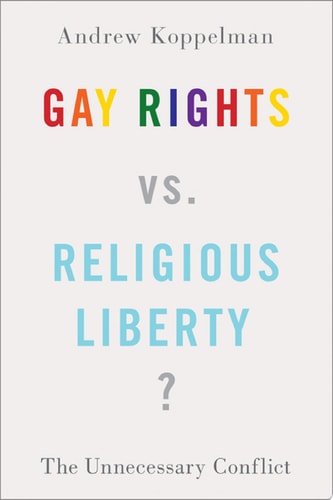
Gay Rights vs. Religious Liberty: The Unnecessary Conflict
0
0
As an Amazon Associate and affiliate partner, Menrva Books earns from qualifying purchases. Learn more
Author Description
Should religious people who conscientiously object to facilitating same-sex weddings, and who therefore decline to provide cakes, photography, or other services, be exempted from antidiscrimination laws? This issue has taken on an importance far beyond the tiny number who have made such claims. Gay rights advocates fear that exempting even a few religious dissenters would unleash a devastating wave of discrimination. Conservative Christians fear that the law will treat them like racists and drive them to the margins of American society.Both sides are mistaken. The answer lies, not in abstract principles, but in legislative compromise. This book clearly and empathetically engages with both sides of the debate. Koppelman explains the basis of antidiscrimination law, including the complex idea of dignitary harm. He shows why even those who do not regard religion as important or valid nonetheless have good reasons to support religious liberty, and why even those who regard religion as a value of overriding importance should nonetheless reject the extravagant power over nonbelievers that the Supreme Court has recently embraced.Koppelman also proposes a specific solution to the problem: that religious exemptions be granted only to the few businesses that are willing to announce their compunctions and bear the costs of doing so. His approach makes room for America's enormous variety of deeply held beliefs and ways of life. It can help reduce the toxic polarization of American politics.
Menrva's Summary
THE THESIS
This book investigates whether religious exemptions from antidiscrimination laws are necessary or if they represent a false dichotomy between gay rights and religious liberty. Andrew Koppelman, a professor of law and political science, utilizes legal history and constitutional theory to argue that the current polarization surrounding this issue is based on misunderstandings of both antidiscrimination law and religious freedom. He proposes a legislative compromise that balances the protection of dignitary interests with the accommodation of sincere religious beliefs.
THE SCOPE MAP
What You Will Find
- Analysis of the legal concept of dignitary harm in the context of public accommodations.
- A historical overview of how antidiscrimination laws have evolved in the United States.
- A proposed legislative framework for granting narrow religious exemptions to businesses.
- Examination of Supreme Court jurisprudence regarding religious liberty and its impact on nonbelievers.
THE AUTHORITY PERSPECTIVE
Legal scholars and political commentators frequently note the book's balanced approach to a highly contentious social issue. Experts highlight this as a pragmatic contribution to the discourse on religious freedom and civil rights, noting that Koppelman provides a clear, accessible framework for legislative reform.
Page Count:
214
Publication Date:
2020-06-02
Publisher:
Oxford University Press
ISBN-10:
0197500986
ISBN-13:
9780197500989
Politics
Religion
Human rights
Law
Sociology
Theology Practical
Public Policy
Community Tags
Similar Books