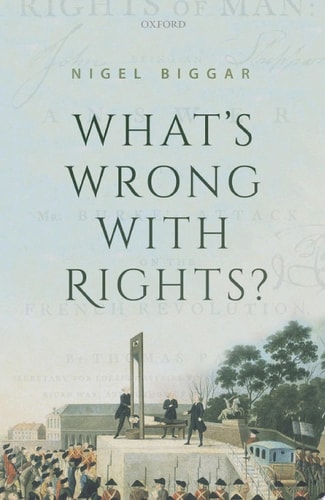
What's Wrong with Rights?
0
0
As an Amazon Associate and affiliate partner, Menrva Books earns from qualifying purchases. Learn more
Author Description
Are natural rights 'nonsense on stilts', as Jeremy Bentham memorably put it? Must the very notion of a right be individualistic, subverting the common good? Should the right against torture be absolute, even though the heavens fall? Are human rights universal or merely expressions of Western neo-imperial arrogance? Are rights ethically fundamental, proudly impervious to changing circumstances? Should judges strive to extend the reach of rights from civil Hamburg to anarchical Basra? Should judicial oligarchies, rather than legislatures, decide controversial ethical issues by inventing novel rights? Ought human rights advocates learn greater sympathy for the dilemmas facing those burdened with government? These are the questions that What's Wrong with Rights? addresses. In doing so, it draws upon resources in intellectual history, legal philosophy, moral philosophy, moral theology, human rights literature, and the judgments of courts. It ranges from debates about property in medieval Christendom, through Confucian rights-scepticism, to contemporary discussions about the remedy for global hunger and the justification of killing. And it straddles assisted dying in Canada, the military occupation of Iraq, and genocide in Rwanda. What's Wrong with Rights? concludes that much contemporary rights-talk obscures the importance of fostering civic virtue, corrodes military effectiveness, subverts the democratic legitimacy of law, proliferates publicly onerous rights, and undermines their authority and credibility. The solution to these problems lies in the abandonment of rights-fundamentalism and the recovery of a richer public discourse about ethics, one that includes talk about the duty and virtue of rights-holders.
Menrva's Summary
THE THESIS
This book investigates whether contemporary human rights discourse has become detached from civic virtue and democratic legitimacy, ultimately undermining the very authority it seeks to uphold. Nigel Biggar, a scholar of moral theology and ethics, examines the historical and philosophical foundations of rights-talk. By synthesizing intellectual history, legal philosophy, and moral theology, he argues that the modern tendency toward 'rights-fundamentalism' obscures the necessity of duties and virtues. The author contends that this shift threatens the stability of democratic institutions and the effectiveness of governance.
THE SCOPE MAP
What You Will Find
- Historical analysis of property rights from medieval Christendom to modern times.
- Comparative study of Confucian rights-scepticism versus Western frameworks.
- Case studies including military operations in Iraq, assisted dying in Canada, and the Rwandan genocide.
Scope Limits
- The text does not provide a comprehensive legal manual for human rights litigation.
- It does not offer a detailed policy roadmap for specific international human rights organizations.
THE AUTHORITY PERSPECTIVE
Scholars and critics frequently note the academic density and interdisciplinary breadth of Biggar's arguments. Experts often highlight this work as a significant contribution to the critical re-evaluation of modern rights-based political frameworks.
Page Count:
374
Publication Date:
2020-01-01
Publisher:
OUP Oxford
ISBN-10:
0192606549
ISBN-13:
9780192606549
Philosophy
Religion
Legal Theory
Ethics
Political Philosophy
Intellectual History
Moral theology
Human rights
Community Tags
Other Editions(5)

Similar Books


Reader Comments
Share Your Thoughts
No comments yet. Be the first to share your thoughts!