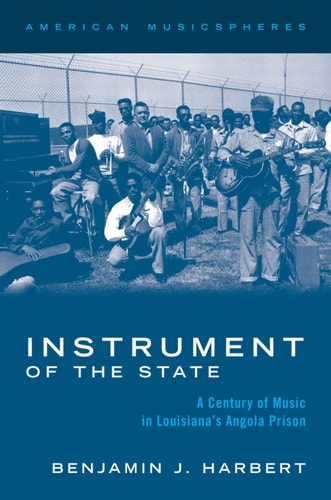
Instrument of the State: A Century of Music in Louisiana's Angola Prison
0
0
As an Amazon Associate and affiliate partner, Menrva Books earns from qualifying purchases. Learn more
Author Description
Louisiana State Penitentiary is one of the largest and most brutal maximum-security prisons in the United States. Built on the grounds of a former plantation, the prison is commonly referred to as "Angola" apropos of the country of origin for many of the enslaved people who inhabited the land. Despite notoriously inhumane conditions within the prison, people incarcerated at Angola have sustained a rich and dynamic musical legacy since the late nineteenth century, attracting folklorists such as John and Alan Lomax and Harry Oster. Well-known musicians including Huddie William "Lead Belly" Ledbetter, Charles Neville, and James Booker played a part in this history, in addition to a litany of others who proved vital to the prison's musical culture but for various reasons were unable to establish their careers upon release.In Instrument of the State, author Benjamin J. Harbert interweaves oral history and archival research to show how incarcerated musicians find small but essential freedoms by performing jazz, R&B, country, gospel, rock, and fusion throughout the Twentieth Century. In doing so, he expands folkloric definitions of "prison music." considering the ways in which music manifests among the incarcerated and the prison's administration as a lens to better understand state power and the fragments of hope and joy that remain in its wake. Instrument of the State acts as an indictment of the carceral state, highlighting the many ways in which the US penal system disproportionately affects African American people through desperate profiteering of a deliberately underfunded state agency.
Menrva's Summary
THE THESIS
This book investigates how incarcerated musicians at the Louisiana State Penitentiary, known as Angola, have utilized music as a mechanism for survival and resistance against the backdrop of a brutal carceral system. Author Benjamin J. Harbert, an ethnomusicologist, synthesizes extensive oral histories and archival records to examine the intersection of musical expression and state power. He argues that the musical culture within Angola is not merely a byproduct of confinement but a complex manifestation of agency that challenges the dehumanizing structures of the American penal system.
THE SCOPE MAP
What You Will Find
- A historical analysis of musical evolution within Angola from the late nineteenth century through the twentieth century.
- Examination of diverse genres including jazz, R&B, country, gospel, rock, and fusion.
- Primary source interviews with formerly incarcerated musicians and archival documentation from folklorists like John and Alan Lomax.
- A critical framework connecting the prison's history as a former plantation to contemporary issues of systemic inequality and state profiteering.
THE AUTHORITY PERSPECTIVE
Scholars and music historians recognize this work as a significant contribution to the study of prison culture and the sociology of music. Readers frequently note the academic rigor of the research and the author's ability to balance historical documentation with the personal narratives of the incarcerated musicians.
Page Count:
361
Publication Date:
2023-01-01
Publisher:
Oxford University Press
ISBN-10:
0197517536
ISBN-13:
9780197517536
Music
History
Criticism history
Sociology
Humanities
Criminology
Community Tags
Similar Books