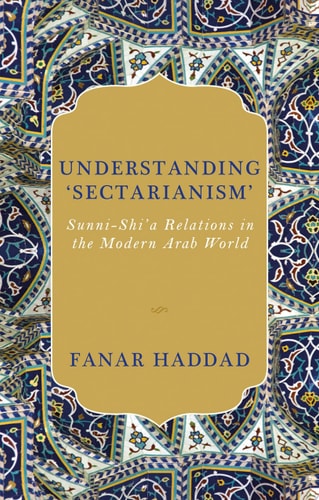
Understanding 'Sectarianism': Sunni-Shi'a Relations in the Modern Arab World
0
0
As an Amazon Associate and affiliate partner, Menrva Books earns from qualifying purchases. Learn more
Author Description
"Sectarianism" is one of the most over-discussed yet under-analyzed concepts in debates about the Middle East. Despite the deluge of commentary, there is no agreement on what "sectarianism" is. Is it a social issue, one of dogmatic incompatibility, a historic one or one purely related to modern power politics? Is it something innately felt or politically imposed? Is it a product of modernity or its antithesis? Is it a function of the nation-state or its negation?This book seeks to move the study of modern sectarian dynamics beyond these analytically paralyzing dichotomies by shifting the focus away from the meaningless '-ism' towards the root: sectarian identity. How are Sunni and Shi'a identities imagined, experienced and negotiated and how do they relate to and interact with other identities?Looking at the modern history of the Arab world, Haddad seeks to understand sectarian identity not as a monochrome frame of identification but as a multi-layered concept that operates on several dimensions: religious, subnational, national and transnational. Far from a uniquely Middle Eastern, Arab, or Islamic phenomenon, a better understanding of sectarian identity reveals that the many facets of sectarian relations that are misleadingly labelled "sectarianism" are echoed in intergroup relations worldwide.
Menrva's Summary
THE THESIS
This book investigates the conceptual ambiguity of 'sectarianism' by shifting the analytical focus from abstract political labels to the lived experience of Sunni and Shi'a identity in the modern Arab world. Fanar Haddad, a scholar specializing in Middle Eastern politics, challenges the binary frameworks that often dominate academic and media discourse. By examining sectarian identity as a multi-layered, fluid construct rather than a static religious phenomenon, the author argues that these dynamics are deeply intertwined with national, subnational, and transnational power structures.
THE SCOPE MAP
What You Will Find
- A critical analysis of the historical and political evolution of Sunni and Shi'a relations in the Arab world.
- A theoretical framework that deconstructs sectarianism into multi-dimensional identity layers.
- Comparative insights that link Middle Eastern intergroup relations to global patterns of social identity.
- An examination of how modern nation-state formation influences the negotiation of religious identity.
THE AUTHORITY PERSPECTIVE
Experts in Middle Eastern studies identify this work as a necessary intervention in the field, noting that it successfully moves beyond simplistic essentialist arguments. Readers frequently highlight the academic rigor of the text, which serves as a foundational resource for understanding the complexities of identity politics in the region.
Page Count:
272
Publication Date:
2020-03-15
Publisher:
Oxford University Press
ISBN-10:
0197510620
ISBN-13:
9780197510629
History
Religion
Sociology
Asia history
Community Tags
Similar Books