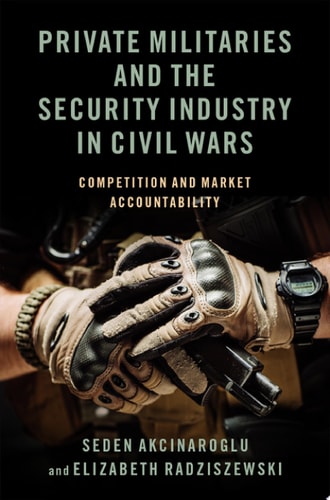
Private Militaries and the Security Industry in Civil Wars: Competition and Market Accountability
0
0
As an Amazon Associate and affiliate partner, Menrva Books earns from qualifying purchases. Learn more
Author Description
Since the 1990s, private military and security companies (PMSCs) have intervened in civil wars around the globe. International, legally registered corporate actors have assisted governments with a myriad of tasks including combat support, logistics, army and police training, intelligence analysis, and guard services. However, reports that such contractors have been responsible for human rights abuses have spurred the need to evaluate the industry's impact on conflicts. Are these contractors effective in curbing violence or does emphasis on profit and lack of accountability get in the way? And how can governments improve PMSCs' commitment to contractual obligations, including adherence to international humanitarian laws?This book identifies two market forces that impact PMSCs' military effectiveness: local or conflict-level competition and global or industry-level competition. Specifically, Seden Akcinaroglu and Elizabeth Radziszewski challenge the assumption that interventions by profit-driven coporations are likely to destabilize areas engaged in war, and provide data that private contractors do contribute to conflict termination under certain circumstances. They argue that competitive market pressure creates a strong monitoring system and that the company's corporate structure and external competitive environment in a given conflict help to explain the variance in accountability to clients. Including an analysis of data on international PMSCs' interventions in civil wars from 1990-2008, Akcinaroglu and Radziszewski show the impact of competition on companies' contribution to the termination of different types of civil wars.
Menrva's Summary
THE THESIS
This book investigates whether market competition among private military and security companies (PMSCs) enhances their effectiveness and accountability in the context of civil wars. Authors Seden Akcinaroglu and Elizabeth Radziszewski utilize a rigorous analytical framework to examine how corporate structures and competitive pressures influence the behavior of these contractors. By analyzing data from 1990 to 2008, the authors argue that market-driven monitoring systems can lead to conflict termination under specific conditions, challenging the prevailing assumption that profit-seeking entities inherently destabilize war-torn regions.
THE SCOPE MAP
What You Will Find
- Analysis of international PMSC interventions in civil wars between 1990 and 2008.
- A theoretical framework distinguishing between local conflict-level competition and global industry-level competition.
- Quantitative data evaluating the correlation between market pressure and adherence to international humanitarian laws.
- Assessment of how corporate structure impacts the ability of contractors to fulfill contractual obligations.
THE AUTHORITY PERSPECTIVE
Experts recognize this work as a significant contribution to the study of private security actors in modern warfare. Readers frequently note the academic density of the prose and the systematic approach to evaluating the complex relationship between profit motives and military outcomes.
Page Count:
248
Publication Date:
2020-01-01
Publisher:
Oxford University Press
ISBN-10:
0197520820
ISBN-13:
9780197520826
Security Studies
Military History
Conflict Resolution
International relations
Community Tags
Similar Books