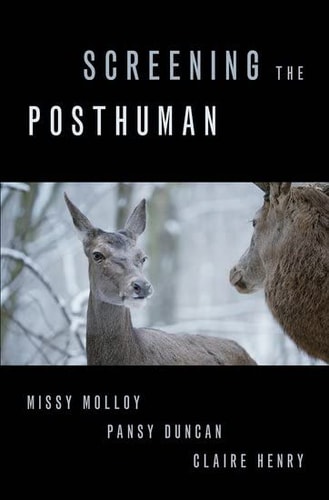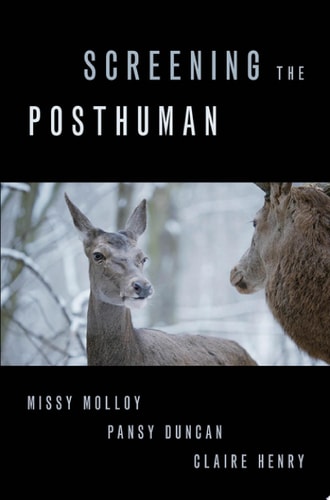
Screening the Posthuman
0
0
As an Amazon Associate and affiliate partner, Menrva Books earns from qualifying purchases. Learn more
Author Description
From AI to climate change, recent technological, ecological, and cultural transformations have unsettled established assumptions about the relationship between the human and the more-than-human world. Screening the Posthuman addresses a heterogenous body of twenty-first century films that turn to the figure of the "posthuman" as a means of exploring this development.Through close analyses of films as diverse as Kûki ningyô [Air Doll] (dir. Hirokazu Koreeda 2009), Testrol és lélekrol [On Body and Soul] (dir. Ildiko Enyedi 2017) and Nomadland (dir. Chloé Zhao 2020), this wide-ranging volume shows that, while often identified as the remit of science fiction, the posthuman on screen crosses filmic genres, national contexts, and industrial settings. In the process, posthuman cinema emphasizes humanity's entanglement in broader biological, technological, and social worlds and exposes new models of subjectivity, community, and desire.In advancing these arguments, Screening the Posthuman draws on scholarship associated with critical posthumanist theory―an ongoing project unified by a decentering of the "human". As the first systematic, full-length application of this body of scholarship to cinema, Screening the Posthuman advocates for a rigorous posthumanist critique that avoids both humanist nostalgia and transhumanist fantasy in its attention to the excitements and anxieties of posthuman experience.
Menrva's Summary
THE THESIS
This volume investigates how twenty-first-century cinema utilizes the figure of the posthuman to challenge traditional anthropocentric perspectives in an era defined by rapid technological and ecological change. Authors Claire Henry, Missy Molloy, and Pansy Duncan synthesize critical posthumanist theory with film analysis to demonstrate that the posthuman is not merely a trope of science fiction, but a pervasive presence across global cinema. By examining the entanglement of human subjects within broader biological and technological networks, the authors propose a framework for understanding contemporary subjectivity that rejects both humanist nostalgia and transhumanist fantasy.
THE SCOPE MAP
What You Will Find
- A comprehensive application of critical posthumanist theory to the medium of film.
- Comparative analyses of international cinema, including works from Japan, Hungary, and the United States.
- Examination of diverse filmic genres ranging from art-house drama to speculative fiction.
- Theoretical exploration of subjectivity, desire, and community within the context of the more-than-human world.
THE AUTHORITY PERSPECTIVE
Scholars and film critics recognize this work as a foundational text for applying posthumanist theory to cinematic studies. Readers frequently note the academic density of the prose, which serves as a rigorous resource for those interested in the intersection of philosophy and visual media.
Page Count:
316
Publication Date:
2023-06-03
Publisher:
Oxford University Press
ISBN-10:
0197538568
ISBN-13:
9780197538562
Philosophy
Knowledge Theory
Mass media
Film Studies
Motion pictures
Technology
Media Studies