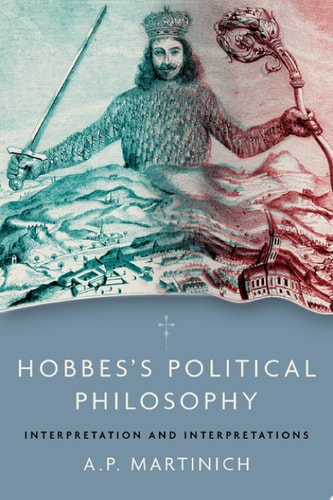
Hobbes's Political Philosophy: Interpretation and Interpretations
0
0
As an Amazon Associate and affiliate partner, Menrva Books earns from qualifying purchases. Learn more
Author Description
Thomas Hobbes, the greatest English political philosopher, argued that human beings needed government in order to save their lives from being "solitary, poor, nasty, brutish, and short." They form governments by making a contract with each other to support a sovereign, to whom they give their right of governing themselves. In other words, government is artificial and not natural to human beings. Hobbes's arguments are formidable, but often unacceptable. For example, few people believe Hobbes's claim that the authority of their government is unlimited. Government needs to be limited in some way, such as a system of check and balances, to prevent tyranny. Identifying exactly where Hobbes went wrong is difficult, but also illuminates the truth about government.Hobbes's Political Philosophy: Interpretation and Interpretations aims to clarify Hobbes's positions by examining what Hobbes considered a science of politics, a set of timeless truths grounded in definitions. A.P. Martinich explains this science of politics, examining Hobbes's views on the laws of nature, authorization and representation, sovereignty by acquisition, and others. He argues that in addition to the timeless science, Hobbes had two timebound projects. The first was to eliminate the apparent conflict between the new science of Copernicus and Galileo and traditional Christian doctrine by distinguishing science from religion and understanding Christianity as essentially belief in the literal meaning of the Bible. The second was to show that Christianity is not politically destabilizing by appealing to biblical teachings such as "Servants, obey your masters," and "All authority comes from God."In examining Hobbes's views on political philosophy, Martinich gives a comprehensive overview of Hobbes's historical context and puts his arguments in dialogue with other interpretations of Hobbes's philosophy, drawing on the work of scholars such as Jeffrey Collins, Edwin Curley, John Deigh, and Quentin Skinner. T
Menrva's Summary
THE THESIS
This work investigates the core question of how Thomas Hobbes’s political philosophy functions as a coherent science of politics while simultaneously addressing specific, time-bound religious and historical concerns. A.P. Martinich, a scholar of early modern philosophy, utilizes a rigorous analytical framework to dissect Hobbes’s foundational texts. He argues that Hobbes’s political theory is not merely a static set of definitions but a complex system designed to reconcile scientific inquiry with Christian doctrine and political stability.
THE SCOPE MAP
What You Will Find
- An examination of Hobbes’s laws of nature, authorization, and sovereignty by acquisition.
- A methodology that distinguishes between Hobbes’s timeless political science and his time-bound religious projects.
- A comparative analysis of Hobbes’s work against contemporary scholarly interpretations by figures such as Quentin Skinner and Edwin Curley.
- A historical contextualization of Hobbes’s efforts to harmonize the scientific advancements of Copernicus and Galileo with traditional Christian belief.
THE AUTHORITY PERSPECTIVE
Scholars and students of political theory frequently cite this text as a vital resource for navigating the complexities of Hobbesian interpretation. Experts highlight the book’s ability to synthesize dense historical context with precise philosophical analysis, making it a standard reference for those studying the evolution of sovereignty.
Page Count:
304
Publication Date:
2021-07-09
Publisher:
Oxford University Press
ISBN-10:
0197531717
ISBN-13:
9780197531716
History
Philosophy
Non-Fiction
Political Philosophy
Community Tags
Similar Books