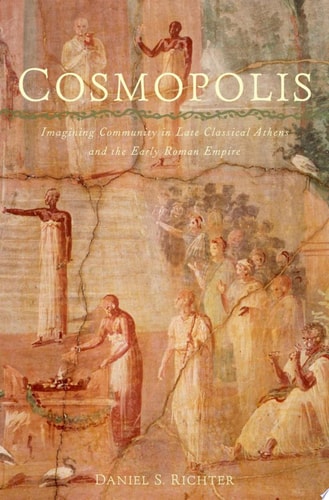
Cosmopolis: Imagining Community in Late Classical Athens and the Early Roman Empire
0
0
As an Amazon Associate and affiliate partner, Menrva Books earns from qualifying purchases. Learn more
Author Description
This is a book about the ways in which various intellectuals in the post-classical Mediterranean imagined the human community as a unified, homogenous whole composed of a diversity of parts. More specifically, it explores how authors of the second century CE adopted and adapted a particular ethnic and cultural discourse that had been elaborated by late fifth- and fourth-century BCE Athenian intellectuals. At the center of this book is a series of contests over the meaning of lineage and descent and the extent to which the political community is or ought to be coterminous with what we might call a biologically homogenous collectivity. The study suggests that early imperial intellectuals found in late classical and early Hellenistic thought a way of accommodating the claims of both ethnicity and culture in a single discourse of communal identity. The idea of the unity of humankind evolved in the fifth and fourth centuries as a response to and an engine for the creation of a rapidly shrinking and increasingly integrated oikoumenê. The increased presence of outsiders in the classical city-state as well as the creation of sources of authority that lay outside of the polis destabilized the idea of the polis as a kin group (natio). Beginning in the early fourth century and gaining great momentum in the wake of Alexander's conquest of the East, traditional dichotomies such as Greek and barbarian lost much of their explanatory power. In the second-century CE, by contrast, the empire of the Romans imposed a political space that was imagined by many to be coterminous with the oikoumenê itself. One of the central claims of this study is that the forms of cosmopolitan and ecumenical thought that emerged in both moments did so as responses to the idea that the natio - the kin group - is (or ought to be) the basis for any human collectivity.
Menrva's Summary
THE THESIS
This study investigates how intellectuals in the second century CE adapted late classical Athenian discourse to conceptualize the human community as a unified, homogenous entity despite internal diversity. Daniel S. Richter examines the evolution of ethnic and cultural identity from the fifth century BCE through the early Roman Empire. By analyzing the tension between the polis as a kin-based group and the emerging ideal of a universal human community, the author argues that imperial thinkers utilized classical frameworks to reconcile ethnicity with broader cultural integration.
THE SCOPE MAP
What You Will Find
- Analysis of intellectual responses to the integration of the Mediterranean oikoumenê.
- Examination of the shift from the polis as a natio to a broader, inclusive political identity.
- Comparative study of fifth-century BCE Athenian thought and second-century CE Roman imperial discourse.
Scope Limits
- Does not provide a comprehensive history of Roman political administration.
- Does not focus on the daily lives of non-intellectual populations during these periods.
THE AUTHORITY PERSPECTIVE
Scholars recognize this work as a rigorous examination of the intellectual history surrounding ancient cosmopolitanism and ethnic identity. Readers frequently note the academic density of the prose, which is intended for specialists in classical history and political theory.
Page Count:
304
Publication Date:
2011-01-01
Publisher:
Oxford University Press
ISBN-10:
0190454199
ISBN-13:
9780190454197
History
Rome
Community Life
Cultural History
Political Philosophy
Ancient History
Greece
Sociology
Community Tags
Similar Books