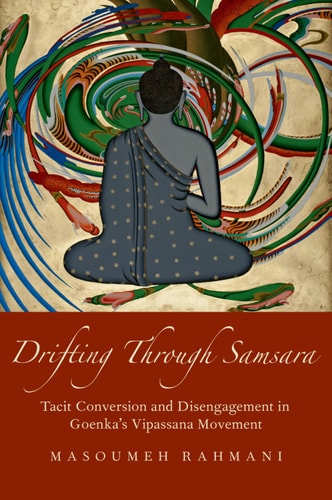
Drifting through Samsara: Tacit Conversion and Disengagement in Goenka's Vipassana Movement
0
0
As an Amazon Associate and affiliate partner, Menrva Books earns from qualifying purchases. Learn more
Author Description
In Drifting Through Samsara, Masoumeh Rahmani provides a fieldwork-based study of Goenka's Vipassana meditation movement in New Zealand. This group is distinguished by its refusal to identify as Buddhist and by a rich rhetorical repertoire for repackaging Theravada Buddhist teachings in pseudo-scientific and secular language. Drawing from qualitative research, the book examines the way the movement's discourse shapes unique processes and narratives of conversion and disengagement. Rahmani argues that conversion to this movement is tacit and paradoxically results in the members' rejection of religious labels and categories including conversion. Tracing the linguistic changes associated with the process of conversion and increased commitment, she outlines three main disengagement pathways: (1) pragmatic leaving, (2) disaffiliation, and (3) deconversion. Pragmatic leavers are individuals who were disengaged prior to developing a commitment. Rahmani argues that the language of these leavers is characterised by pragmatisms, dualistic discourse, and ambivalence, and their post-disengagement involves an active gravitation towards practices with easily accomplished goals. Disaffiliates and deconverts are individuals who disengaged after years of intense commitment to the movement. One of the distinguishing features of disaffiliation narratives is self-doubt resulting from the movement's ambiguous discourse regarding progress. For these people post-disengagement often involves the retrospective adoption of Buddhist identity.Rahmani finds that as a consequence of its linguistic strategies, deconversion is a rare exit pattern from this movement. In general, however, the themes and characteristics of both disaffiliation and deconversion fit the contours of exit from other traditions, even though conversion was tacit in the first place. The book thus questions the normative participant recruitment approach in conversion studies and argues that a simple reliance on the informants
Menrva's Summary
THE THESIS
This study investigates how the Vipassana meditation movement founded by S.N. Goenka utilizes secularized, pseudo-scientific rhetoric to facilitate tacit conversion while simultaneously discouraging traditional religious identification. Masoumeh Rahmani, an anthropologist, employs qualitative fieldwork conducted in New Zealand to analyze the linguistic and social mechanisms of this movement. By examining the discourse used by practitioners, the author argues that the movement's unique framing of Buddhist teachings creates a paradoxical environment where members reject religious labels even as they undergo deep ideological commitment. The research provides a framework for understanding how such movements manage member retention and exit pathways.
THE SCOPE MAP
What You Will Find
- A detailed analysis of the Goenka Vipassana movement's rhetorical strategies and secularized language.
- A classification of three distinct disengagement pathways: pragmatic leaving, disaffiliation, and deconversion.
- Qualitative data derived from extensive fieldwork and interviews with movement participants in New Zealand.
- An examination of the linguistic shifts that occur during the process of commitment and eventual departure from the group.
THE AUTHORITY PERSPECTIVE
Scholars in the sociology of religion highlight this work as a significant contribution to the study of conversion processes within non-traditional religious groups. The text is noted for its academic rigor and its challenge to normative recruitment models in contemporary conversion studies.
Page Count:
257
Publication Date:
2021-01-01
Publisher:
Oxford University Press
ISBN-10:
0197579981
ISBN-13:
9780197579985
Religion
Anthropology
General Anthropology
Buddhism
Sociology
Meditation
Community Tags
Other Editions(2)
Similar Books















Reader Comments
Share Your Thoughts
No comments yet. Be the first to share your thoughts!