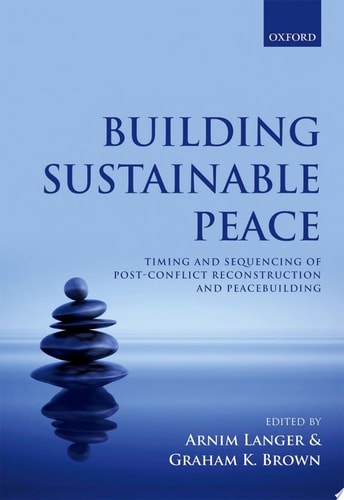
Building Sustainable Peace
0
0
As an Amazon Associate and affiliate partner, Menrva Books earns from qualifying purchases. Learn more
Author Description
Countries Emerging From Civil War Or Protracted Violence Often Face The Daunting Challenge Of Rebuilding Their Economy While Simultaneously Creating The Political And Social Conditions For A Stable Peace. The Implicit Assumption In The International Community That Rapid Political Democratisation Along With Economic Liberalisation Holds The Key To Sustainable Peace Is Belied By The Experiences Of Countries Such As Iraq And Afghanistan. Often, The Challenges Of Post-conflict Reconstruction Revolve Around The Timing And Sequencing Of Different Reform That May Have Contradictory Implications. Drawing On A Range Of Thematic Studies And Empirical Cases, This Book Examines How Post-conflict Reconstruction Policies Can Be Better Sequenced In Order To Promote Sustainable Peace. The Book Provides Evidence That Many Reforms That Are Often Thought To Be Imperative In Post-conflict Societies May Be Better Considered As Long-term Objectives, And That The Immediate Imperative For Such Societies Should Be 'people-centred' Policies.
Menrva's Summary
THE THESIS
This book investigates how post-conflict reconstruction policies can be effectively sequenced to foster long-term stability rather than immediate, often destabilizing, political and economic liberalization. Arnim Langer and Graham K. Brown, both recognized scholars in international development and conflict studies, analyze the failures of rapid democratization in regions like Iraq and Afghanistan. They argue that the international community often prioritizes premature structural reforms over the immediate, necessary focus on people-centered policies that address the fundamental needs of societies emerging from violence.
THE SCOPE MAP
What You Will Find
- Comparative analysis of post-conflict reconstruction strategies.
- Theoretical framework for sequencing political and economic reforms.
- Empirical case studies examining diverse post-conflict environments.
Scope Limits
- The text does not provide a universal blueprint for all conflict zones.
- It does not focus on military intervention tactics or tactical peacekeeping operations.
THE AUTHORITY PERSPECTIVE
Experts identify this work as a critical contribution to the discourse on peacebuilding and state reconstruction. Readers frequently note the academic density of the prose, which serves as a rigorous resource for policymakers and students of international relations.
Page Count:
496
Publication Date:
2016-01-01
Publisher:
Oxford University Press
ISBN-10:
0191074535
ISBN-13:
9780191074530
Economics
Peace studies
Conflict Resolution
International relations
Community Tags
Other Editions(2)

Similar Books