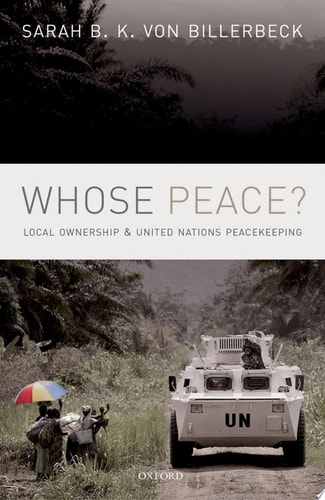
Whose Peace?
0
0
As an Amazon Associate and affiliate partner, Menrva Books earns from qualifying purchases. Learn more
Author Description
Recent Years Have Seen An Increasing Emphasis On Local Ownership In United Nations Peacekeeping. Advocates Assert That It Boosts The Legitimacy And Sustainability Of Peacekeeping By Helping To Preserve The Principles Of Self-determination And Non-imposition In An Activity That Can Contravene Them. However, Whether This Assertion Holds In Practice Has Not Been Backed Up By Careful Conceptual And Empirical Analysis. This Book Fills This Gap By Mapping The Discourse, Understandings, And Operationalization Of Local Ownership In Un Peacekeeping, Both From The Perspective Of The Un And Local Actors. Drawing On The Case Of The Un Peacekeeping Operation In Dr Congo And A Number Of Other Cases, It Shows That Despite Its Regular Invocation Of Local Ownership Discourse, The Un Operationalizes Ownership In Restrictive Ways That Are Intended To Protect The Achievement Of Operational Goals But Which Consequently Limit Self-determination And Increase External Imposition On The Host Country. This Gap Between The Rhetoric And Reality Of Ownership Suggests That The Un Uses Local Ownership Primarily As A Discursive Tool For Legitimation, One Intended To Reconcile Conflicting Normative And Operational Imperatives That It Faces. However, Because Its Actions Do Not Match Its Rhetoric, The Un's Attempts To Generate Legitimacy Through Discourse Appear To Fall Flat, Particularly In The Eyes Of Local Actors, And Because Of Contradictions In The Ways That The Un Operationalizes Local Ownership, It Also Inhibits The Achievement Of Its Operational Goals As Well.
Menrva's Summary
THE THESIS
This book investigates whether the United Nations' emphasis on local ownership in peacekeeping missions effectively promotes self-determination or merely serves as a rhetorical tool for institutional legitimation. Sarah B. K. von Billerbeck, a scholar in international relations, utilizes a combination of conceptual analysis and empirical field research to evaluate the gap between UN policy rhetoric and operational reality. The author argues that the UN frequently restricts local agency to prioritize its own operational goals, ultimately undermining the very principles of self-determination it claims to uphold.
THE SCOPE MAP
What You Will Find
- A detailed mapping of the discourse and operationalization of local ownership within UN peacekeeping frameworks.
- Comparative analysis of multiple peacekeeping missions, with a primary focus on the UN operation in the Democratic Republic of Congo.
- An examination of the disconnect between the perspectives of international UN officials and local actors on the ground.
Scope Limits
- The analysis does not provide a comprehensive history of all UN peacekeeping missions, focusing instead on specific cases that illustrate the tension between rhetoric and practice.
- The study does not offer a prescriptive manual for future peacekeeping operations but rather a critical assessment of current institutional behavior.
THE AUTHORITY PERSPECTIVE
Experts in international relations and conflict studies recognize this work as a rigorous critique of contemporary peacekeeping norms. Readers frequently note the academic density of the prose and the author's meticulous use of case studies to challenge institutional narratives.
Page Count:
240
Publication Date:
2016-01-01
Publisher:
Oxford University Press
ISBN-10:
0191072338
ISBN-13:
9780191072338
United Nations
International relations
Conflict Resolution
Peacekeeping
Community Tags
Other Editions(2)
Similar Books