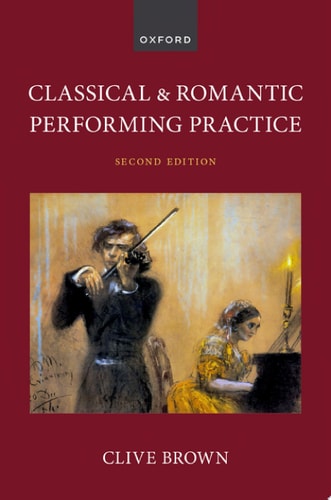
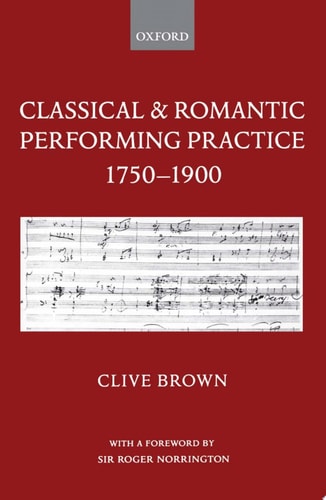
Classical and Romantic Performing Practice
0
0
As an Amazon Associate and affiliate partner, Menrva Books earns from qualifying purchases. Learn more
Author Description
This book investigates the changing ways in which composers employed notation and musicians understood it between the middle of the eighteenth century and the start of the twentieth century. While explicit notational practices were increasingly the norm throughout this time, many aspects of performance--even as late as the late nineteenth century--were assumed rather than specified and it was still widely understood that much had to be read between the lines. Furthermore, during the twentieth century the intended implications of many previous notational practices were gradually forgotten and are now generally misunderstood, while others--such as continuous vibrato and the meticulous observance of vertical synchrony and notated rhythms--differ radically from anything the composer might have envisaged.Drawing upon early recordings, documentary evidence, and the few surviving mechanical instruments, author Clive Brown investigates how we might rediscover the subliminal messages Classical and Romantic music notation was intended to convey to performers and argues that composers' intentions for their notation ought not to be confused with their expectations for its execution. The use of expressive practices that often involve substantial deviations from a conventional modern reading of the notation is not only a legitimate but also an essential element in getting closer to the composer's conception. The following topics are investigated over the course of sixteen chapters: metrical and rhetorical accentuation, dynamics, articulation, string-instrument bowing, phrasing, expression, tempo, tempo flexibility, ornamentation and improvisation, asynchrony, arpeggiation, rhythmic flexibility, sliding effects (portamento), and trembling effects (tremolo, vibrato). The book offers ample evidence to demonstrate that, in many respects, the sound worlds in which Mozart, Beethoven, Wagner, and Brahms created their music were more radically different from ours than is generally assume
Menrva's Summary
THE THESIS
This book investigates the historical divergence between eighteenth- and nineteenth-century musical notation and modern performance interpretations, arguing that contemporary musicians frequently misunderstand the implicit performance instructions intended by composers. Clive Brown, a scholar of historical performance, utilizes a synthesis of early sound recordings, primary source documents, and mechanical instrument data to reconstruct the performance aesthetics of the Classical and Romantic eras. He posits that modern adherence to literal notation often obscures the expressive flexibility and stylistic nuances that were standard during the time of composers like Mozart and Brahms.
THE SCOPE MAP
What You Will Find
- Analysis of metrical and rhetorical accentuation, dynamics, and articulation techniques.
- Examination of string-instrument bowing, portamento, and vibrato practices.
- Evidence derived from early audio recordings and historical mechanical instruments.
- A framework for distinguishing between a composer's written notation and their expected performance execution.
THE AUTHORITY PERSPECTIVE
Musicologists and performers frequently cite this work as a foundational text for understanding the gap between modern literalism and historical performance norms. Experts highlight the rigorous documentation and the author's ability to challenge long-standing assumptions about how Classical and Romantic repertoire should sound.
Page Count:
944
Publication Date:
2025-02-18
Publisher:
Oxford University Press
ISBN-10:
0197581617
ISBN-13:
9780197581612
Music
Music History
Musical Genres
Musicology
Performance theory
Performance Practice
Community Tags
Other Editions(3)
Similar Books

Reader Comments
Share Your Thoughts
No comments yet. Be the first to share your thoughts!