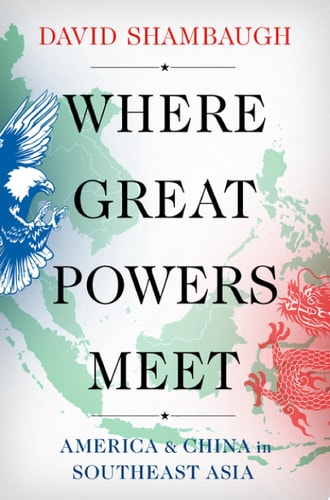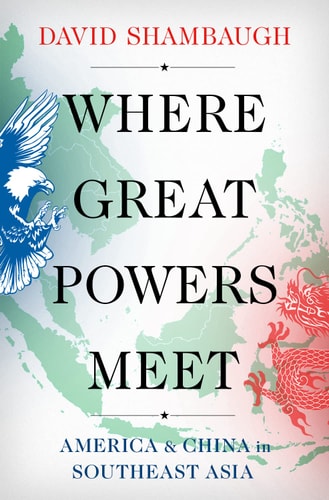
Where Great Powers Meet: America & China in Southeast Asia
0
0
As an Amazon Associate and affiliate partner, Menrva Books earns from qualifying purchases. Learn more
Author Description
After the end of the Cold War, it seemed as if Southeast Asia would remain a geopolitically stable region within the American-led order for the foreseeable future. In the last two decades, however, the re-emergence of China as a major great power has called into question the geopolitical future of the region and raised the specter of renewed great power competition.As the eminent China scholar David Shambaugh explains in Where Great Powers Meet, the United States and China are engaged in a broad-gauged and global competition for power. While this competition ranges across the entire world, it is centered in Asia. In this book, Shambaugh focuses on the critical sub-region of Southeast Asia. The United States and China constantly vie for position and influence across this enormously significant area--and the outcome of this contest will do much to determine whether Asia leaves the American orbit after seven decades and falls into a new Chinese sphere of influence. Just as importantly, to the extent that there is a global "power transition" occurring from the US to China, the fate of Southeast Asia will be a good indicator. Presently, both powers bring important assets to bear in their competition. The United States continues to possess a depth and breadth of security ties, soft power, and direct investment across the region that empirically outweigh China's. For its part, China has more diplomatic influence, much greater trade, and geographic proximity. In assessing the likelihood of a regional power transition, Shambaugh examines how ASEAN (the Association of Southeast Asian Nations) and its member states maneuver and the degree to which they align with one or the other power.
Menrva's Summary
THE THESIS
This book investigates the shifting geopolitical landscape of Southeast Asia as it becomes the primary theater for competition between the United States and China. David L. Shambaugh, a prominent scholar of Chinese affairs, utilizes extensive regional analysis and historical context to evaluate the ongoing power transition. He argues that the future of the American-led order in the region depends on how individual ASEAN nations navigate the competing economic and security interests of these two global powers.
THE SCOPE MAP
What You Will Find
- An analysis of the geopolitical competition between the United States and China within the Southeast Asian sub-region.
- A detailed examination of ASEAN and its member states' strategic maneuvering between the two powers.
- A comparative assessment of the assets each power brings to the region, including security ties, soft power, trade, and geographic proximity.
- A framework for understanding the broader global power transition from the United States to China.
THE AUTHORITY PERSPECTIVE
Experts recognize this work as a critical, data-driven analysis of contemporary regional dynamics in Asia. Readers frequently note the clarity of the author's prose and the depth of his research into the complex diplomatic relationships between ASEAN nations and the two competing superpowers.
Page Count:
352
Publication Date:
2022-09-13
Publisher:
Oxford University Press
ISBN-10:
0197667341
ISBN-13:
9780197667347
History
Geopolitics
Asia history
Foreign Policy
Asian Studies
International relations
Community Tags
Similar Books