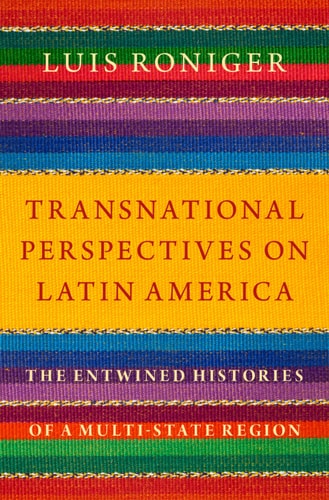
Transnational Perspectives on Latin America: The Entwined Histories of a Multi-State Region
0
0
As an Amazon Associate and affiliate partner, Menrva Books earns from qualifying purchases. Learn more
Author Description
Latin America is a region made up of multiple states and societies with a diversity of races, ethnicities, and cultures. These states share historical legacies, cultural backgrounds and institutional frameworks, as well as political and socioeconomic challenges--but can one say they share a "regional perspective," if such perspectives even exist? In Transnational Perspectives on Latin America, Luis Roniger argues that the notion of Latin America is significant for understanding these societies' multiple connections and spillover across state boundaries. He claims that cross-border networks, a protracted concern and at times involvement in the affairs of neighboring states have shaped the region's modern character as much as the process of nation-state formation. Geopolitical, sociological, and cultural trends molded a contiguity of influences, leading sometimes to state confrontations, but overall, shaping a transnational arena of connected histories, interactions, and visions, complementing the process of separate nation-state formation. The book offers fresh readings of the dynamics of this region of multiple societies that have shared historical and cultural connections and developed divergent paths while unable to fully disengage from one another. Its chapters analyze persisting forms of circulation and articulation of networks, practices and ideas crossing international borders. Among the topics covered are political exile; the interface of state building and transnationalism; wars and the diffusion of conspiracy theories; the transnational imprint of the Cold War and democratization; social movements and transnational solidarity; states' geopolitical shifts and their impact on Jewish and Muslim citizens. The book closes with a chapter on twenty-first century dilemmas and challenges, including the process of segmented regional integration, state accountability, the vitality and limits of citizenship regimes, and pandemic politics.
Menrva's Summary
THE THESIS
This book investigates whether a cohesive regional perspective exists within Latin America by analyzing the complex, interconnected histories of its multiple states. Luis Roniger, a scholar of Latin American history and sociology, utilizes a transnational framework to argue that the region's modern character is defined as much by cross-border networks and spillover as it is by individual nation-state formation. He examines how geopolitical, sociological, and cultural influences have created a contiguity of shared experiences that prevent these societies from fully disengaging from one another.
THE SCOPE MAP
What You Will Find
- Analysis of political exile and the interface between state building and transnationalism.
- Examination of the Cold War's transnational imprint and its impact on regional democratization.
- Discussion of social movements, transnational solidarity, and the influence of geopolitical shifts on minority populations.
- Evaluation of twenty-first-century challenges including state accountability, citizenship regimes, and pandemic politics.
THE AUTHORITY PERSPECTIVE
Scholars and students of Latin American history frequently cite this work for its ability to synthesize disparate national narratives into a unified transnational framework. The text is recognized for its academic rigor and its comprehensive approach to the socio-political dynamics that continue to shape the region today.
Page Count:
336
Publication Date:
2021-01-01
Publisher:
Oxford University Press
ISBN-10:
0197605338
ISBN-13:
9780197605332
History
Comparative Politics
Transnationalism
Sociology
America history
International relations
Community Tags
Similar Books