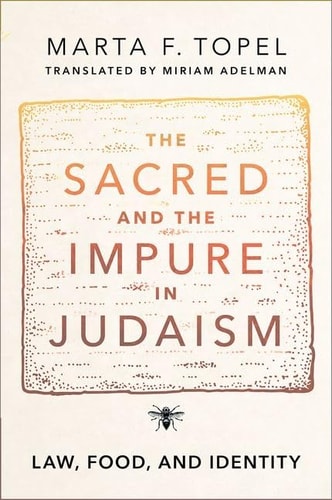
The Sacred and the Impure in Judaism: Law, Food, and Identity
0
0
As an Amazon Associate and affiliate partner, Menrva Books earns from qualifying purchases. Learn more
Author Description
The Sacred and the Impure in Judaism examines the radicalization of certain Orthodox Jewish groups through the lens of kashrut, or Jewish dietary laws. Mata F. Topel begins with a historical look at chumratization--the tendency among rabbis toward more rigorous interpretations of Jewish law--beginning in Hungary in the late 19th century and on through the nascent radicalization of Israeli Orthodox Jews in the 1950s.Then, drawing on Orthodox kashrut manuals and interviews with kashrut supervisors, ritual butchers, and a diverse group of Orthodox men and women, Topel shows how changes to dietary laws have had a profound effect on the ritual density of everyday life in these communities. Detailed descriptions of the difficulties that Orthodox housewives have in carrying out preparations for the Jewish Passover reveal a certain obsession with following the commandments and customs mandated by authorities. Contrasting medieval practices with current ones, Topel shows that the number of rules for celebrating Passover has increased exponentially in recent decades, an important indication of the chumratization process that effects significant segments of this population. However, she also finds exceptions: While many Orthodox rabbis demand that kashrut supervisors and housewives take great pains to avoid ingesting insects that may be found in vegetables and fruit, they have also become significantly more lenient when it comes to consuming non-kosher meat--so much so that most meat consumed by Orthodox communities today is not kosher.The Sacred and the Impure in Judaism reveals considerable changes in the content and function of kashrut for Orthodox Jews in Israel and its diaspora, which contradicts ideas of purity within this community and the notion that their beliefs and practices are identical to European Judaism of the 18th and 19th centuries, while highlighting the multiple and intricate relationships that exist between a community's religion, food, and identity.
Menrva's Summary
THE THESIS
This book investigates how the process of chumratization—the trend toward increasingly rigorous interpretations of Jewish dietary law—has fundamentally reshaped the ritual life and identity of Orthodox Jewish communities. Marta F. Topel, an expert in Jewish studies, utilizes a combination of historical analysis and contemporary ethnographic research to examine the evolution of kashrut practices. By contrasting 19th-century European traditions with modern Israeli and diaspora customs, the author argues that the intensification of these laws reflects broader shifts in religious identity and community boundaries.
THE SCOPE MAP
What You Will Find
- Historical analysis of the chumratization process originating in 19th-century Hungary.
- Ethnographic data derived from interviews with kashrut supervisors, ritual butchers, and Orthodox families.
- Comparative study of medieval versus modern Passover preparation requirements.
- Analysis of the paradoxical leniency regarding non-kosher meat consumption alongside strict vegetable inspection protocols.
THE AUTHORITY PERSPECTIVE
Scholars and sociologists of religion recognize this work as a significant contribution to the study of contemporary Orthodox practice and the sociology of food. Readers frequently note the academic density of the prose and the author's ability to synthesize complex historical trends with intimate, modern-day observations.
Page Count:
190
Publication Date:
2024-01-01
Publisher:
Oxford University Press
ISBN-10:
0197677665
ISBN-13:
9780197677667
Politics
History
Religion
Food Studies
Sociology
Judaism
Movements
Jewish Life
Community Tags
Similar Books


Reader Comments
Share Your Thoughts
No comments yet. Be the first to share your thoughts!