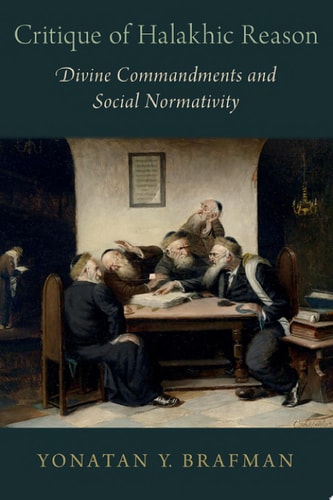
Critique of Halakhic Reason: Divine Commandments and Social Normativity
0
0
As an Amazon Associate and affiliate partner, Menrva Books earns from qualifying purchases. Learn more
Author Description
Norms and obligations are central components of many religious traditions. Yet they have often been neglected as objects of reflection in the study of religion relative to belief, experience, and even the related category of ritual. More surprisingly, despite the centrality of mitzvah (commandment) in Judaism, halakhah (Jewish law) has only recently become a central topic in modern Jewish thought. This book rectifies these deficiencies while forging new connections between reflection on religion and modern Jewish thought by offering what it calls a critique of halakhic reason. Such a critique delineates the rational constraints on the justification of the commandments and the practical consequences for their jurisprudence. It also asks whether uniquely "religious reasons" even exist and draws conclusions for several areas of study.Critique of Halakhic Reason offers fresh assessments of twentieth century Jewish thinkers, including Joseph Soloveitchik, Yeshayahu Leibowitz, and Eliezer Berkovits, as deeply engaged in reason-giving about the commandments yet simultaneously denying the normativity of practical reason. Against them, it contends that, when reasons are understood as generated by the structure of agency and the relations among subjects, they are the source of normativity. This constructivist theory of practical reason provides a basis for conceptions of authority, norms, and obligations that are applicable even to God's commands. Divine commandments too operate within a "space of reasons," and so are constrained by rationality and morality. Whether commandments are justified and how they are implemented depends on the reasons offered for and against them by humans. Reasons and practices of reason-giving are thus central to religious thought and life.Yonatan Y. Brafman examines the reasoning operative in the justification and jurisprudence of the Jewish commandments, and develops the consequences of reasoning for the study and philosophy of religion.
Menrva's Summary
THE THESIS
This book investigates the rational constraints and normative foundations of divine commandments within the framework of Jewish law, or halakhah. Yonatan Y. Brafman, a scholar of modern Jewish thought, utilizes a constructivist theory of practical reason to challenge the traditional separation between religious authority and human rationality. By analyzing the works of twentieth-century thinkers like Joseph Soloveitchik and Yeshayahu Leibowitz, Brafman argues that divine commands operate within a space of reasons, meaning their justification and implementation are inherently linked to human agency and moral deliberation.
THE SCOPE MAP
What You Will Find
- A critical analysis of twentieth-century Jewish philosophers including Soloveitchik, Leibowitz, and Berkovits.
- A constructivist framework for understanding the relationship between practical reason and religious normativity.
- An exploration of the jurisprudence of mitzvah and its role in modern religious thought.
- A philosophical argument regarding the intersection of divine authority and human moral reasoning.
THE AUTHORITY PERSPECTIVE
Scholars in the field of religious studies and Jewish philosophy identify this work as a significant contribution to the intersection of legal theory and theology. Readers frequently note the academic density of the prose, which requires a strong background in both philosophical ethics and halakhic discourse to fully navigate.
Page Count:
352
Publication Date:
2024-01-01
Publisher:
Oxford University Press
ISBN-10:
0197767931
ISBN-13:
9780197767931
Philosophy
Religion
Jewish Life
Law
Ethics
Judaism
Theology
Jewish Studies
Community Tags
Similar Books