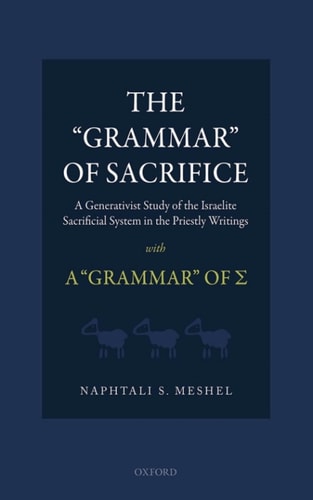
The 'Grammar' of Sacrifice: A Generativist Study of the Israelite Sacrificial System in the Priestly Writings with A 'Grammar' of Σ
0
0
As an Amazon Associate and affiliate partner, Menrva Books earns from qualifying purchases. Learn more
Author Description
The notion that rituals, like natural languages, are governed by implicit, rigorous rules led scholars in the last century, harking back to the early Indian grammarian Patañjali, to speak of a "grammar", or "syntax", of ritual, particularly sacrificial ritual. Despite insightful examples of ritual complexes that follow hierarchical rules akin to syntactic structures in natural languages, and ambitious attempts to imagine a Universal Grammar of sacrificial ritual, no single, comprehensive "grammar" of any ritual system has yet been composed. This book offers the first such "grammar." Centering on Σ—the idealized sacrificial system represented in the Priestly laws in the Pentateuch—it demonstrates that a ritual system is describable in terms of a set of concise, unconsciously internalized, generative rules, analogous to the grammar of a natural language. Despite far-reaching diachronic developments, reflected in Second Temple and rabbinic literature, the ancient Israelite sacrificial system retained a highly unchangeable "grammar," which is abstracted and analysed in a formulaic manner. The limits of the analogy to linguistics are stressed: rather than categories borrowed from linguistics, such as syntax and morphology, the operative categories of Σ are abstracted inductively from the ritual texts: zoemics—the study of the classes of animals used in ritual sacrifice; jugation-the rules governing the joining of animal and non-animal materials; hierarchics-the tiered structuring of sacrificial sequences; and praxemics—the analysis of the physical activity comprising sacrificial procedures. Finally, the problem of meaning in non-linguistic ritual systems is addressed.
Menrva's Summary
THE THESIS
This book investigates whether the Israelite sacrificial system, as presented in the Priestly writings of the Pentateuch, can be formally described using a generative grammar model analogous to natural language. Naphtali S. Meshel, a scholar in biblical studies, utilizes a structuralist framework to analyze the Priestly laws. He argues that the sacrificial system, referred to as Σ, operates through a set of internalized, formulaic rules that govern ritual procedures regardless of diachronic shifts in religious practice.
THE SCOPE MAP
What You Will Find
- A formal generative model for the Priestly sacrificial system (Σ).
- Four primary analytical categories: zoemics, jugation, hierarchics, and praxemics.
- An inductive analysis of ritual texts from the Pentateuch.
Scope Limits
- The study does not provide a universal grammar applicable to all global ritual systems.
- It does not focus on the historical or sociological evolution of sacrifice in Second Temple or rabbinic literature, except to note the stability of the underlying grammar.
THE AUTHORITY PERSPECTIVE
Experts in biblical studies and ritual theory recognize this work as a significant methodological contribution to the structural analysis of ancient religious texts. Readers frequently note the technical density of the prose, which requires a foundational understanding of both linguistics and Hebrew Bible scholarship.
Page Count:
320
Publication Date:
2014-01-01
Publisher:
OUP Oxford
ISBN-10:
0191015458
ISBN-13:
9780191015458
Bible Study
Theology
Kindle eBooks
Kindle Store
Categories
Ritual Studies
Judaism
Near East
Jewish Life
Linguistics