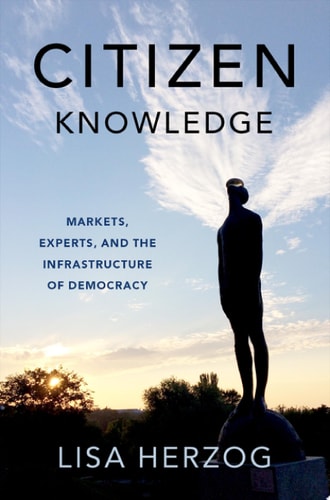
Citizen Knowledge: Markets, Experts, and the Infrastructure of Democracy
0
0
As an Amazon Associate and affiliate partner, Menrva Books earns from qualifying purchases. Learn more
Author Description
Many democratic societies currently struggle with issues around knowledge: fake news, distrust of experts, a fear of technocratic tendencies. In Citizen Knowledge, Lisa Herzog discusses how knowledge, understood in a broad sense, should be dealt with in societies that combine a democratic political system with a capitalist economic system. How do citizens learn about politics? How do new scientific insights make their way into politics? What role can markets play in processing decentralized knowledge?Herzog takes on the perspective of "democratic institutionalism," which focuses on the institutions that enable an inclusive and stable democratic life. She argues that the fraught relation between democracy and capitalism gets out of balance if too much knowledge is treated according to the logic of markets rather than democracy. Complex societies need different mechanisms for dealing with knowledge, among which markets, democratic deliberation, and expert communities are central. Citizen Knowledge emphasizes the responsibility of bearers of knowledge and the need to support institutions that promote active and informed citizenship. Through this lens, Herzog develops the vision of an egalitarian society that considers the use of knowledge in society not a matter of markets, but of shared democratic responsibility, supported by epistemic infrastructures. As such, Herzog's argument contributes to political epistemology, a new subdiscipline of philosophy, with a specific focus on the interrelation between economic and political processes.Citizen Knowledge draws from both the history of ideas and systematic arguments about the nature of knowledge to propose reforms for a more unified and flourishing democratic system.This is an open access title available under the terms of a CC BY-NC-ND 4.0 International license. It is free to read at Oxford Scholarship Online and offered as a free PDF download from OUP and selected open access locations.
Menrva's Summary
THE THESIS
How can democratic societies effectively manage the distribution and validation of knowledge within the competing frameworks of capitalist markets and democratic institutions? Lisa Herzog, a scholar in political philosophy, examines the intersection of political epistemology and economic processes to address the crisis of expertise and misinformation. She proposes a framework of democratic institutionalism, arguing that the over-reliance on market logic for knowledge distribution undermines the stability of inclusive democratic life. By analyzing the roles of experts, citizens, and market mechanisms, the author advocates for the development of robust epistemic infrastructures that prioritize shared democratic responsibility over purely commercial interests.
THE SCOPE MAP
What You Will Find
- An analysis of the tension between market-driven knowledge and democratic deliberation.
- A theoretical framework for democratic institutionalism applied to modern political systems.
- Historical perspectives on the evolution of knowledge management in complex societies.
- Proposed institutional reforms to foster active and informed citizenship.
THE AUTHORITY PERSPECTIVE
Experts identify this work as a significant contribution to the emerging field of political epistemology, particularly for its focus on the structural relationship between economic and political processes. Readers frequently note the academic density of the prose, which serves as a foundational text for those studying the intersection of democratic theory and information management.
Page Count:
352
Publication Date:
2023-01-01
Publisher:
Oxford University Press
ISBN-10:
0197681719
ISBN-13:
9780197681718
Philosophy
Economics
Knowledge Theory
Democracy
Epistemology
Sociology
Community Tags
Similar Books