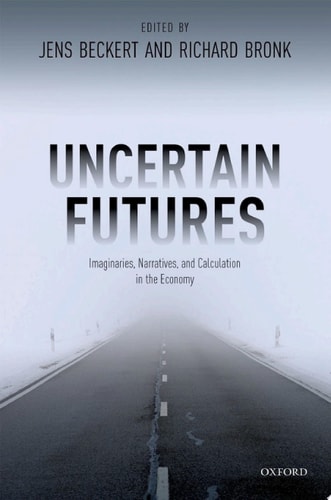
Uncertainty: Individual Problems and Public Solutions
0
0
As an Amazon Associate and affiliate partner, Menrva Books earns from qualifying purchases. Learn more
Author Description
How Much Can We Know? -- Decision-making Under Uncertainty, Risk, And Ambiguity -- Attempts To Turn Uncertainty Into Risk -- Knowledge As A Remedy For Uncertainty -- The Hermeneutics Of Knowledge -- Private Ways Of Reducing Uncertainty -- Public Ways Of Reducing Uncertainty -- Outline -- Part I: Principles Of States Of The World -- 2. Informal Institutions -- Informal And Formal Institutions -- From Struggle To Informal Institutions -- The Lifeworld Of Informal Institutions -- Institutionalization How Informal Institutions Show Up -- How Do Institutions Reduce Uncertainty? -- Conclusion -- 3. Formal Institutions -- Decisions For Others In Public -- Setting Laws -- Standards -- Conclusion -- 4. Evaluation -- Evaluations And Their Prevalence -- Evaluation Against Objective Scales -- Evaluation As A Discourse-towards Decisions For Others -- Conclusion -- Part Ii: Forms Producing States Of The World5. Convaluation -- 5. Convaluation -- Convaluations As Forms -- Value Uncertainty -- Mutual Adjustment -- Grown And Decided Forms Of Convaluations Producer Markets As Grown Economic Convaluations -- Convaluations As Result Of Decisions-organization -- Elections As Decided Convaluations -- Exchange Markets As Decided Convaluations -- Conclusion -- 6. Deciding For Others -- Valuation Arising From Decisions For Others -- Valuation As An Evaluation Discourse -- Reviews -- Ratings -- Prizes As Indirect Competition -- Rankings -- Predictions -- Conclusion -- 7. Contest -- Concepts Of Contest -- From Violence To Peaceful Contests -- Indirect Contests And Competition -- The Culture Of Contest -- The Making Of Forms Of Contest -- Conclusion 8. Making And Reducing Uncertainty -- The Making Of Means Of Uncertainty Reduction -- Addressing Uncertainty -- The Opportunity Of Uncertainty -- Existential Uncertainty Reduction -- Private Truth Claims And The Public -- Appendix. A Typology Of Convaluations -- Notes -- References -- Index Patrik Aspers. Includes Bibliographical References And Ind
Menrva's Summary
THE THESIS
How do individuals and societies construct mechanisms to navigate and mitigate the inherent unpredictability of the world? Patrik Aspers, a professor of sociology, examines the intersection of individual decision-making and public institutional frameworks. By synthesizing economic theory with sociological inquiry, he argues that uncertainty is not merely a void to be filled with data, but a fundamental condition that necessitates the creation of social forms, institutions, and evaluative practices to facilitate collective action.
THE SCOPE MAP
What You Will Find
- A theoretical framework distinguishing between risk, ambiguity, and existential uncertainty.
- Analysis of informal and formal institutions as primary tools for uncertainty reduction.
- Examination of 'convaluation' processes, including markets, elections, and organizational decision-making.
- Case studies on the role of rankings, ratings, and prizes in shaping public discourse and social order.
THE AUTHORITY PERSPECTIVE
Scholars in the fields of economic sociology and institutional theory identify this work as a rigorous exploration of how social order emerges from chaotic conditions. Readers frequently note the academic density of the prose, which serves as a foundational text for those studying the intersection of valuation and institutional stability.
Page Count:
0
Publication Date:
1900-01-01
Publisher:
Oxford University Pres,
ISBN-10:
0197752780
ISBN-13:
9780197752784
Economics
Risque
Uncertainty
Sociology
Decision Making
Risk
Incertitude
Social Theory
Community Tags
Similar Books