
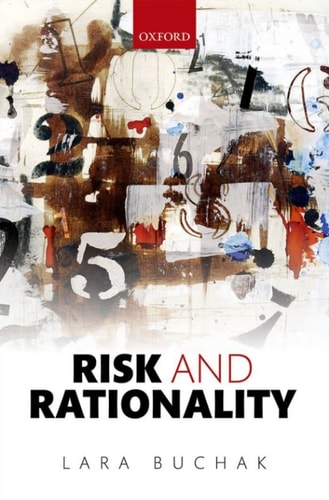
Risk and Rationality
0
0
As an Amazon Associate and affiliate partner, Menrva Books earns from qualifying purchases. Learn more
Author Description
Lara Buchak sets out an original account of the principles that govern rational decision-making in the face of risk. A distinctive feature of these decisions is that individuals are forced to consider how their choices will turn out under various circumstances, and decide how to trade off the possibility that a choice will turn out well against the possibility that it will turn out poorly. The orthodox view is that there is only one acceptable way to do this: rational individuals must maximize expected utility. Buchak's contention, however, is that the orthodox theory (expected utility theory) dictates an overly narrow way in which considerations about risk can play a role in an individual's choices. Combining research from economics and philosophy, she argues for an alternative, more permissive, theory of decision-making: one that allows individuals to pay special attention to the worst-case or best-case scenario (among other 'global features' of gambles). This theory, risk-weighted expected utility theory, better captures the preferences of actual decision-makers. Furthermore, it isolates the distinct roles that beliefs, desires, and risk-attitudes play in decision-making. Finally, contra the orthodox view, Buchak argues that decision-makers whose preferences can be captured by risk-weighted expected utility theory are rational. Thus, Risk and Rationality is in many ways a vindication of the ordinary decision-maker--particularly his or her attitude towards risk--from the point of view of even ideal rationality.
Menrva's Summary
THE THESIS
Does the orthodox expected utility theory provide an exhaustive account of rational decision-making under conditions of risk? Lara Buchak, a philosopher specializing in decision theory, challenges the traditional economic consensus that maximizing expected utility is the sole criterion for rationality. By synthesizing formal decision theory with philosophical inquiry, she proposes the risk-weighted expected utility theory, which accounts for how individuals weigh best-case and worst-case scenarios differently than standard models predict.
THE SCOPE MAP
What You Will Find
- A formal mathematical framework for risk-weighted expected utility theory.
- A comparative analysis between standard expected utility theory and risk-sensitive alternatives.
- Philosophical arguments regarding the separation of beliefs, desires, and risk attitudes.
- A defense of the rationality of non-standard risk preferences in human decision-making.
THE AUTHORITY PERSPECTIVE
Experts in philosophy and decision theory recognize this work as a significant contribution to the formal study of rational choice. Readers frequently note the technical density of the prose, which requires a foundational understanding of probability theory and economic modeling to fully grasp the author's arguments.
Page Count:
272
Publication Date:
2017-07-25
Publisher:
Oxford University Press
ISBN-10:
0198801289
ISBN-13:
9780198801283
Economics
Philosophy
Reason
Decision Making
Risk
Decision Theory
Mind & Body
Rationality
Community Tags
Other Editions(4)


Similar Books

Reader Comments
Share Your Thoughts
No comments yet. Be the first to share your thoughts!