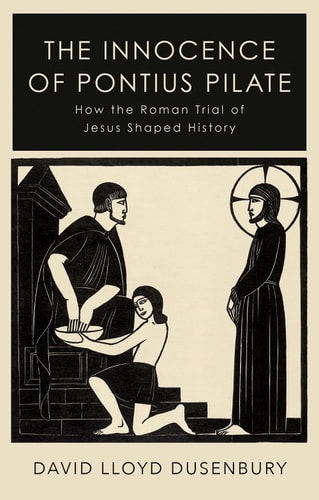
The Innocence of Pontius Pilate: How the Roman Trial of Jesus Shaped History
0
0
As an Amazon Associate and affiliate partner, Menrva Books earns from qualifying purchases. Learn more
Author Description
The gospels and ancient historians agree: Jesus was sentenced to death by Pontius Pilate, the Roman imperial prefect in Jerusalem. To this day, Christians of all churches confess that Jesus died 'under Pontius Pilate'. But what exactly does that mean?Within decades of Jesus' death, Christians began suggesting that it was the Judaean authorities who had crucified Jesus--a notion later echoed in the Qur'an. In the third century, one philosopher raised the notion that, although Pilate had condemned Jesus, he'd done so justly; this idea survives in one of the main strands of modern New Testament criticism. So what is the truth of the matter? And what is the history of that truth?David Lloyd Dusenbury reveals Pilate's 'innocence' as not only a neglected theological question, but a recurring theme in the history of European political thought. He argues that Jesus' interrogation by Pilate, and Augustine of Hippo's North African sermon on that trial, led to the concept of secularity and the logic of tolerance emerging in early modern Europe. Without the Roman trial of Jesus, and the arguments over Pilate's innocence, the history of empire--from the first century to the twenty-first--would have been radically different.
Menrva's Summary
THE THESIS
This work investigates how the historical and theological debate surrounding the innocence of Pontius Pilate served as a catalyst for the development of Western political concepts, specifically secularity and tolerance. David Lloyd Dusenbury, a scholar of political theology, examines the trial of Jesus as a foundational moment in European intellectual history. By analyzing the intersection of Roman imperial law, early Christian doctrine, and the writings of Augustine of Hippo, the author argues that the interrogation of Jesus by Pilate established a logic that continues to influence modern governance and the history of empire.
THE SCOPE MAP
What You Will Find
- An analysis of the trial of Jesus as a pivotal event in the evolution of European political thought.
- A historical examination of the shifting interpretations of Pilate's culpability from the first century to the modern era.
- A study of Augustine of Hippo's sermons and their impact on the emergence of secularity.
- An exploration of how theological arguments regarding Roman authority shaped the logic of tolerance in early modern Europe.
THE AUTHORITY PERSPECTIVE
Scholars and readers frequently note the intellectual rigor and historical breadth of Dusenbury's analysis. Experts highlight this text as a significant contribution to the study of political theology and the historical development of Western secularism.
Page Count:
411
Publication Date:
2024-01-01
Publisher:
Oxford University Press
ISBN-10:
0197764924
ISBN-13:
9780197764923
Religion
History
Philosophy
Church History
Church Leadership
Theology
Community Tags
Similar Books