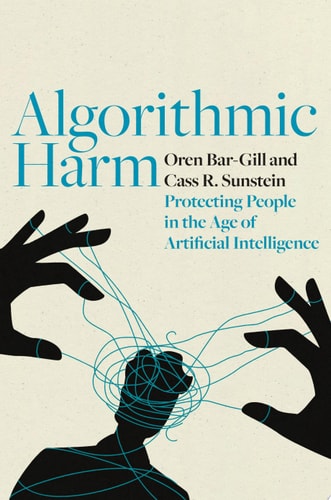
Algorithmic Harm: Protecting People in the Age of Artificial Intelligence
0
0
As an Amazon Associate and affiliate partner, Menrva Books earns from qualifying purchases. Learn more
Author Description
Will algorithms help people or hurt them? What about artificial intelligence in general? If consumers know what they need to know and do not suffer from behavioral biases, algorithms and AI are likely to be helpful. Consumers will be more likely to get what they want and need. But if consumers lack information, algorithms in particular will be able to convince them to make harmful or foolish choices. And if consumers suffer from behavioral biases, such as unrealistic optimism or a focus on the short term, algorithms will be able to produce serious harms.In Algorithmic Harm: Protecting People in the Age of Artificial Intelligence, Oren Bar-Gill and Cass Sunstein consider the harms and benefits of AI and algorithms and catalog the different ways in which algorithms are being or may be used in consumer and other markets. The authors identify the market conditions under which these uses injure consumers and consider policy and regulatory responses that could reduce the risks consumers, investors, workers, and voters face now―and in the future. Democracy and self-government are at risk; there is a great deal that can be done to reduce that risk.
Menrva's Summary
THE THESIS
This book investigates the specific conditions under which artificial intelligence and algorithmic systems transition from beneficial tools to instruments of consumer exploitation and democratic erosion. Oren Bar-Gill and Cass R. Sunstein, both distinguished legal scholars, utilize behavioral economics and regulatory theory to analyze how information asymmetry and cognitive biases allow algorithms to manipulate decision-making. They argue that without targeted policy interventions, the current trajectory of AI deployment poses significant risks to individual autonomy, market integrity, and the stability of democratic institutions.
THE SCOPE MAP
What You Will Find
- Analysis of behavioral biases such as unrealistic optimism and short-termism in digital environments.
- A catalog of algorithmic applications across consumer, labor, and political markets.
- Evaluation of regulatory frameworks designed to mitigate risks to investors, workers, and voters.
- Theoretical models explaining how information gaps facilitate consumer harm.
THE AUTHORITY PERSPECTIVE
Experts recognize this work as a significant contribution to the intersection of behavioral law and emerging technology policy. Readers frequently note the clarity with which the authors translate complex economic theories into actionable regulatory proposals for the digital age.
Page Count:
200
Publication Date:
2025-05-28
Publisher:
Oxford University Press
ISBN-10:
0197778208
ISBN-13:
9780197778203
Economics
Technology
Public Policy
Sociology
Consumer protection
Community Tags
Similar Books