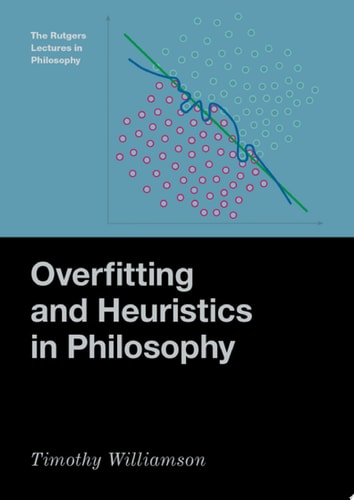
Overfitting and Heuristics in Philosophy
0
0
As an Amazon Associate and affiliate partner, Menrva Books earns from qualifying purchases. Learn more
Author Description
In his Rutgers Lectures, Timothy Williamson explains how contemporary philosophy suffers from a widespread pathology known as overfitting to natural and social scientists, but little understood by most philosophers. Overfitting involves an insufficiently critical attitude towards data, which leads to over-complicated theories designed to fit what are in fact errors in the data. In philosophy, the data typically comprise verdicts on hypothetical or actual cases. Errors in such data can result from our reliance on heuristics, efficient cognitive shortcuts, simple to use but not fully reliable. Just as heuristics embedded in our visual system produce visual illusions, so heuristics embedded in our general cognitive systems produce philosophical paradoxes. Williamson explains the heuristics responsible for paradoxes of vagueness and identity over time, paradoxes of conditionals, paradoxes in ascribing beliefs and other mental states to others, paradoxes of truth and falsity, and paradoxes of weighing reasons and intersectionality. As a case study, Williamson shows how illusions of hyperintensionality can result from a heuristic that projects cognitively significant differences in how explanations are presented onto supposed differences in the non-linguistic world, which then form the starting point for metaphysicians' theorizing. In each case, Williamson provides independent evidence that we commonly use the heuristic, and that it sometimes leads us astray. In short, we are being suckered by our own heuristics, and the result is overfitting. Williamson also discusses how philosophers can best avoid these problems. Williamson's important diagnosis and prescription will be of interest to a wide range of philosophers.
Menrva's Summary
THE THESIS
This work investigates the philosophical pathology of overfitting, wherein theorists construct overly complex models based on flawed data derived from unreliable cognitive heuristics. Timothy Williamson, a prominent analytic philosopher, utilizes his Rutgers Lectures to argue that philosophers frequently mistake cognitive shortcuts for objective truth. By examining how these heuristics generate paradoxes in areas such as vagueness, identity, and mental state ascription, he provides a framework for identifying and mitigating the influence of these systematic errors in contemporary philosophical inquiry.
THE SCOPE MAP
What You Will Find
- An analysis of the overfitting phenomenon as applied to philosophical theory construction.
- A detailed examination of cognitive heuristics and their role in producing philosophical paradoxes.
- Case studies focusing on vagueness, identity over time, conditionals, and belief ascription.
- Methodological recommendations for philosophers to avoid the pitfalls of heuristic-driven theorizing.
THE AUTHORITY PERSPECTIVE
Experts recognize this text as a significant contribution to meta-philosophy and the intersection of cognitive science with traditional analytic methods. Readers frequently note the technical density of the prose, which assumes a strong background in contemporary analytic philosophy and formal logic.
Page Count:
312
Publication Date:
2024-09-04
Publisher:
Oxford University Press
ISBN-10:
0197779212
ISBN-13:
9780197779217
Philosophy
Politics
Methodology
Logic
Epistemology
Metaphysics
Community Tags
Other Editions(3)

Similar Books





Reader Comments
Share Your Thoughts
No comments yet. Be the first to share your thoughts!