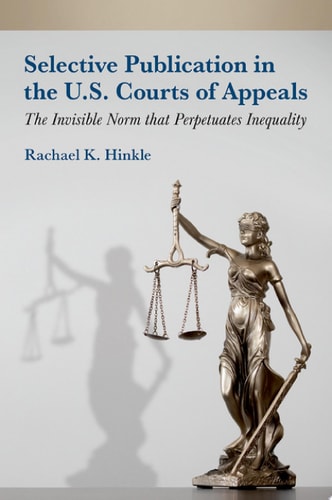
Selective Publication in the U.S. Courts of Appeals: The Invisible Norm that Perpetuates Inequality
0
0
As an Amazon Associate and affiliate partner, Menrva Books earns from qualifying purchases. Learn more
Author Description
Since the 1970s, federal circuit courts have designated some decisions as unpublished as a means of keeping up with an increasing number of appeals, yet still providing quality legal analysis. These unpublished opinions declare that they will only resolve the dispute in question rather than have the rulings act as binding precedent. Scholars have since focused on policy and the law-making function of circuit courts which avoids the difficult task of grappling with the massive number of unpublished decisions. The distinction between published and unpublished rulings has created a breeding ground for disparities in power and privilege that raise serious concerns about social justice. Nearly four out of five decisions are unpublished.Selective Publication in the U.S. Courts of Appeals: The Invisible Norm that Perpetuates Inequality presents a comprehensive examination of the theoretical and empirical implications of a key institutional practice in a highly influential set of courts. This book sheds light on the social justice consequences of not publishing all opinions by drawing on an original dataset of over 200,000 cases. Hinkle's rigorous analysis reveals how the seemingly benign institutional feature of selective publication contributes to problematic differences in the way resources and demographic features shape power and privilege in the circuit courts.This book exposes how the decision to publish or not publish an opinion plays a significant role in who gets what, when, and how in a court of law. Academics and students will find Selective Publication in the U.S. Courts of Appeals an accessible tool for understanding circuit courts as an important political institution. Those who shape and are affected by circuit rules will gain important insight about the implications of existing rules that can inform ongoing discussions regarding potential reforms.
Menrva's Summary
THE THESIS
Does the practice of selective publication in U.S. circuit courts systematically reinforce existing power imbalances and social inequality? Rachael K. Hinkle, a scholar of judicial politics, investigates the institutional mechanisms behind unpublished opinions, which currently account for nearly eighty percent of circuit court output. By analyzing an original dataset of over 200,000 cases, the author argues that the discretion to designate rulings as non-precedential functions as an invisible norm that disproportionately affects litigants based on their resources and demographic characteristics.
THE SCOPE MAP
What You Will Find
- An empirical analysis of over 200,000 federal circuit court cases spanning several decades.
- A theoretical framework explaining the intersection of judicial efficiency and the law-making function of courts.
- Quantitative evidence linking selective publication practices to disparities in power and privilege.
- A critical examination of how institutional rules influence the distribution of legal outcomes and social justice.
THE AUTHORITY PERSPECTIVE
Experts identify this work as a significant contribution to the study of judicial behavior and institutional design. Readers frequently note the clarity of the empirical analysis, which makes complex legal data accessible to both students and practitioners interested in court reform.
Page Count:
200
Publication Date:
2024-10-11
Publisher:
Oxford University Press
ISBN-10:
0197770088
ISBN-13:
9780197770085
Politics
Judicial System
Court Records
Systems Theory
Law
Legal Studies
Federal Jurisdiction
Social justice
Community Tags
Similar Books