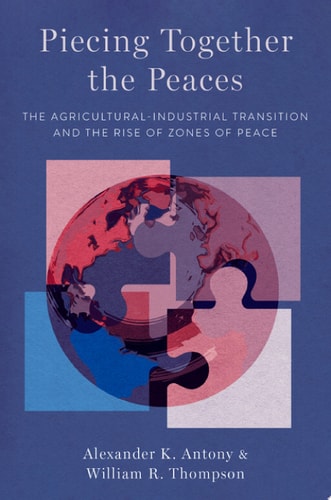
Piecing Together the Peaces: The Agricultural-Industrial Transition and the Rise of Zones of Peace
0
0
As an Amazon Associate and affiliate partner, Menrva Books earns from qualifying purchases. Learn more
Author Description
The Purpose Of An Introduction Is To Tell The Reader What A Book Is And Is Not About. This Book Has Three Goals. One Is To Modify An Interpretation Of Economic And Political Development Constructed By North, Wallis, And Weingast (2009) That Focuses On The Emergence Of Limited And Open Access Societies. Their Interpretation Already Has An Explanation For Domestic Violence; We Want To Alter It So That It Can Also Account For International Violence. We Also Think It Needs More Attention To What Drives Developmental Change. As It Stands Now, Their Discussion Hints Strongly About Causation But Prefers To Keep Such Issues As Exogenous To Its Argument. We Prefer To Endogenize At Least Some Part Of The Causal Drivers Of Greater Pacification. However, There Are Major Limits To The Extent To Which We Can Test This Macro-theory Currently. More Ambitious Testing Will Come With Time. In The Interim, Our Second Goal Is To Demonstrate The Role Of Industrialization And Movement Away From An Agrarian Political Economy, One Of The Primary Causal Drivers Of Economic And Political Development, In Reducing Interstate Violence. We Do This By Delineating The Reasons Why And How De-agrarianization Is Critical To Understanding Contemporary War And Peace Issues. We Do This In Part By Focusing On Four Of The Main Peace Arguments: The Democratic Peace, The Capitalist Peace, Economic Interdependence, And Boundary Settlement Or Territorial Peace. All Four Are Linked To The Transition From The Dominance Of Agricultural Strategies To The Dominance Of Industrial Strategies In Various Ways. We Also Think That They Are Not Really Explanatory Competitors But Rather Complementary Interpretations That Choose To Focus On Different Dimensions Of Pacification Phenomena. This Point Of View Becomes Clearer When We Compare The Explanatory Power Of Each Of The Four Alternatives In The Context Of An Indicator Of De-agrarianization. Most Of The Alternatives Survive These Empirical Tests But At Much Reduced Expla
Menrva's Summary
THE THESIS
This book investigates how the transition from agrarian-based economies to industrial societies serves as a primary driver for the reduction of interstate violence. Authors Alexander K. Antony and William R. Thompson build upon the framework established by North, Wallis, and Weingast to expand the analysis of societal development to include international conflict. By endogenizing the causal drivers of pacification, the authors argue that industrialization is a critical, often overlooked factor in the stability of modern nation-states.
THE SCOPE MAP
What You Will Find
- A comparative analysis of four major peace theories: Democratic Peace, Capitalist Peace, Economic Interdependence, and Territorial Peace.
- A theoretical framework linking the decline of agrarian dominance to the rise of international peace zones.
- Empirical testing of developmental indicators against historical patterns of interstate conflict.
- A critique of existing models that treat causal drivers of development as exogenous factors.
THE AUTHORITY PERSPECTIVE
Experts in international relations view this work as a significant attempt to synthesize economic development theory with security studies. Readers frequently note the academic density of the prose, which is intended for scholars and students engaged in political economy and conflict research.
Page Count:
304
Publication Date:
2024-08-16
Publisher:
Oxford University Press
ISBN-10:
0197782221
ISBN-13:
9780197782224
History
Politics
Economics
Specific Topics
International relations
Sociology
Community Tags
Similar Books








Reader Comments
Share Your Thoughts
No comments yet. Be the first to share your thoughts!