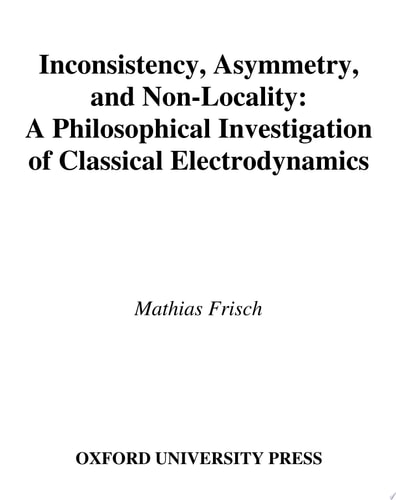
Inconsistency, Asymmetry, and Non-Locality: A Philosophical Investigation of Classical Electrodynamics
0
0
As an Amazon Associate and affiliate partner, Menrva Books earns from qualifying purchases. Learn more
Author Description
Mathias Frisch provides the first sustained philosophical discussion of conceptual problems in classical particle-field theories. Part of the book focuses on the problem of a satisfactory equation of motion for charged particles interacting with electromagnetic fields. As Frisch shows, the standard equation of motion results in a mathematically inconsistent theory, yet there is no fully consistent and conceptually unproblematic alternative theory. Frisch describes in detail how the search for a fundamental equation of motion is partly driven by pragmatic considerations (like simplicity and mathematical tractability) that can override the aim for full consistency. The book also offers a comprehensive review and criticism of both the physical and philosophical literature on the temporal asymmetry exhibited by electromagnetic radiation fields, including Einstein's discussion of the asymmetry and Wheeler and Feynman's influential absorber theory of radiation. Frisch argues that attempts to derive the asymmetry from thermodynamic or cosmological considerations fail and proposes that we should understand the asymmetry as due to a fundamental causal constraint. The book's overarching philosophical thesis is that standard philosophical accounts that strictly identify scientific theories with a mathematical formalism and a mapping function specifying the theory's ontology are inadequate, since they permit neither inconsistent yet genuinely successful theories nor thick causal notions to be part of fundamental physics.
Menrva's Summary
THE THESIS
This book investigates the conceptual inconsistencies and ontological challenges inherent in classical particle-field theories, specifically within the framework of classical electrodynamics. Mathias Frisch, a scholar in the philosophy of physics, examines the limitations of standard scientific accounts that equate theories solely with mathematical formalisms. By analyzing the failure of traditional equations of motion and the nature of temporal asymmetry, he argues for a more nuanced understanding of how causal constraints and pragmatic considerations function within fundamental physics.
THE SCOPE MAP
What You Will Find
- Analysis of the mathematical inconsistencies within the standard equation of motion for charged particles.
- A critical review of the physical and philosophical literature regarding temporal asymmetry in electromagnetic radiation.
- Evaluation of the Wheeler-Feynman absorber theory and its implications for radiation.
- A proposed philosophical framework that incorporates thick causal notions into the structure of scientific theories.
THE AUTHORITY PERSPECTIVE
Experts recognize this work as a significant contribution to the philosophy of physics, particularly for its rigorous treatment of the conceptual foundations of classical electrodynamics. Readers frequently note the academic density of the prose, which is intended for those with a background in both theoretical physics and philosophy of science.
Page Count:
222
Publication Date:
2005-01-01
Publisher:
Oxford University Press
ISBN-10:
0198038429
ISBN-13:
9780198038429
Science
Philosophy
Politics
Epistemology
Physics
Nuclear Physics
Categories
Kindle eBooks
Kindle Store
Philosophy history
Community Tags
Similar Books