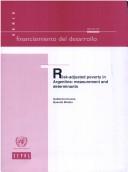
Risk Adjusted Poverty in Argentina
0
0
As an Amazon Associate and affiliate partner, Menrva Books earns from qualifying purchases. Learn more
Author Description
NONE. Menrva holds no usable description for this book. Unless you genuinely and specifically know this published work, set sufficient_material=false. Do NOT infer a plot, characters, or contents from the title.
Menrva's Summary
THE THESIS
This book investigates the concept and measurement of risk-adjusted poverty in Argentina, exploring how different levels of risk exposure impact poverty levels and their persistence. Guillermo Cruces, an economist specializing in poverty and inequality, draws upon extensive data and econometric models to analyze the complex relationship between risk and poverty. The study utilizes microdata from Argentine household surveys to construct measures of poverty that account for income volatility and other socioeconomic risks. The core argument posits that a static view of poverty is insufficient and that understanding risk is crucial for designing effective social policy.
THE SCOPE MAP
- Analysis of poverty measurement methodologies, including risk-adjusted approaches.
- Examination of income volatility and its determinants in the Argentine context.
- Empirical evidence on the correlation between risk exposure and poverty incidence.
- Discussion of policy implications for social protection and poverty reduction strategies.
THE AUTHORITY PERSPECTIVE
This work is recognized for its rigorous econometric approach to understanding poverty dynamics in Argentina. The book is likely to be of interest to academics, policymakers, and researchers focused on development economics and social policy in Latin America. Its detailed analysis of risk-adjusted poverty offers a nuanced perspective beyond traditional poverty metrics.
Page Count:
39
Publication Date:
2003-01-01
ISBN-10:
9211216079
ISBN-13:
9789211216073
Non-Fiction
Economics
Community Tags
Similar Books