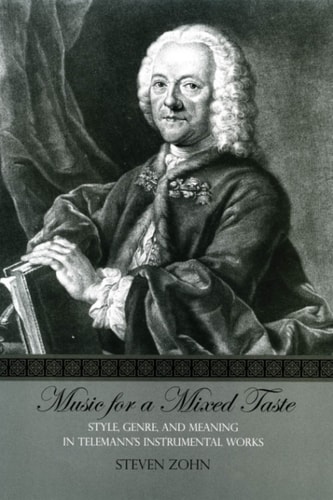
Music for a Mixed Taste: Style, Genre, and Meaning in Telemann's Instrumental Works
0
0
As an Amazon Associate and affiliate partner, Menrva Books earns from qualifying purchases. Learn more
Author Description
Georg Philipp Telemann gave us one of the richest legacies of instrumental music from the eighteenth century. Though considered a definitive contribution to the genre during his lifetime, his concertos, sonatas, and suites were then virtually ignored for nearly two centuries following his death. Yet these works are now among the most popular in the baroque repertory. In Music for a Mixed Taste, Steven Zohn considers Telemann's music from stylistic, generic, and cultural perspectives. He investigates the composer's cosmopolitan "mixed taste"--a blending of the French, Italian, English, and Polish national styles-and his imaginative expansion of this concept to embrace mixtures of the old (late baroque) and new (galant) styles. Telemann had an equally remarkable penchant for generic amalgamation, exemplified by his pioneering role in developing hybrid types such as the sonata in concerto style ("Sonate auf Concertenart") and overture-suite with solo instrument ("Concert en ouverture"). Zohn examines the extramusical meanings of Telemann's "characteristic" overture-suites, which bear descriptive texts associating them with literature, medicine, politics, religion, and the natural world, and which acted as vehicles for the composer's keen sense of musical humor. Zohn then explores Telemann's unprecedented self-publishing enterprise at Hamburg, and sheds light on the previously unrecognized borrowing by J.S. Bach from a Telemann concerto. Music for a Mixed Taste further reveals how Telemann's style polonaise generates musical and social meanings through the timeless oppositions of Orient-Occident, urban-rural, and serious-comic.
Menrva's Summary
THE THESIS
This book investigates how Georg Philipp Telemann utilized a cosmopolitan "mixed taste" to redefine instrumental music in the eighteenth century. Steven Zohn, a musicologist specializing in the baroque era, provides a comprehensive analysis of Telemann's stylistic innovations and his role in the evolution of musical genres. By examining the composer's synthesis of national styles and his pioneering hybrid forms, Zohn argues that Telemann's work represents a sophisticated bridge between the late baroque and the emerging galant style.
THE SCOPE MAP
What You Will Find
- Analysis of Telemann's integration of French, Italian, English, and Polish national styles.
- Examination of hybrid musical forms such as the sonata in concerto style and the overture-suite.
- Investigation into the extramusical meanings and humor found in characteristic overture-suites.
- Documentation of Telemann's self-publishing enterprise and his influence on contemporaries like J.S. Bach.
THE AUTHORITY PERSPECTIVE
Scholars and music historians recognize this work as a definitive study on Telemann's instrumental output and his broader cultural impact. Readers frequently note the academic rigor and detailed musicological analysis that make this text a foundational resource for understanding eighteenth-century musical aesthetics.
Page Count:
720
Publication Date:
2008-01-01
Publisher:
Oxford University Press
ISBN-10:
0198037961
ISBN-13:
9780198037965
Biography
Music
Baroque Music
Humanities
Music History
Criticism history
Musicology
Blues
Community Tags
Similar Books