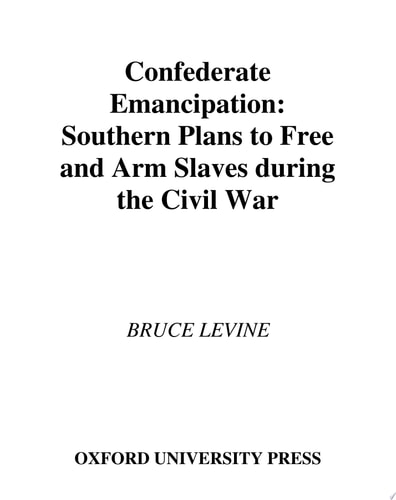
Confederate Emancipation
0
0
As an Amazon Associate and affiliate partner, Menrva Books earns from qualifying purchases. Learn more
Author Description
In Early 1864, As The Confederate Army Of Tennessee Licked Its Wounds After Being Routed At The Battle Of Chattanooga, Major-general Patrick Cleburne (the Stonewall Of The West) Proposed That The Most Courageous Of Our Slaves Be Trained As Soldiers And That Every Slave In The South Who Shall Remain True To The Confederacy In This War Be Freed. In Confederate Emancipation, Bruce Levine Looks Closely At Such Confederate Plans To Arm And Free Slaves. He Shows That Within A Year Of Cleburne's Proposal, Which Was Initially Rejected Out Of Hand, Jefferson Davis, Judah P. Benjamin, And Robert E. Lee Had All Reached The Same Conclusions. At That Point, The Idea Was Debated Widely In Newspapers And Drawing Rooms Across The South, As More And More Slaves Fled To Union Lines And Fought In The Ranks Of The Union Army. Eventually, The Soldiers Of Lee's Army Voted On The Proposal, And The Confederate Government Actually Enacted A Version Of It In March. The Army Issued The Necessary Orders Just Two Weeks Before Appomattox, Too Late To Affect The Course Of The War. Throughout The Book, Levine Captures The Voices Of Blacks And Whites, Wealthy Planters And Poor Farmers, Soldiers And Officers, And Newspaper Editors And Politicians From All Across The South. In The Process, He Sheds Light On Such Hot-button Topics As What The Confederacy Was Fighting For, Whether Black Southerners Were Willing To Fight In Large Numbers In Defense Of The South, And What This Episode Foretold About Life And Politics In The Post-war South. Confederate Emancipation Offers An Engaging And Illuminating Account Of A Fascinating And Politically Charged Idea, Setting It Firmly And Vividly In The Context Of The Civil War And The Part Played In It By The Issue Of Slavery And The Actions Of The Slaves Themselves.
Menrva's Summary
THE THESIS
This book investigates the historical reality and political implications of the Confederate government's late-war proposal to arm and emancipate enslaved people. Bruce Levine, a historian specializing in the American Civil War, utilizes primary source documents including newspapers, personal correspondence, and government records to analyze the shift in Confederate policy. He argues that the desperate military situation forced the Confederate leadership to reconsider the institution of slavery, ultimately revealing the internal contradictions and political desperation of the Southern cause as the war reached its conclusion.
THE SCOPE MAP
What You Will Find
- Analysis of the 1864 proposal by Major-General Patrick Cleburne regarding the arming of enslaved people.
- Examination of the political debates involving Jefferson Davis, Judah P. Benjamin, and Robert E. Lee.
- Documentation of the reactions from diverse social strata, including planters, poor farmers, and enslaved individuals.
- Assessment of the impact of Union military pressure on Confederate legislative decision-making.
THE AUTHORITY PERSPECTIVE
Historians and scholars recognize this work as a rigorous examination of a frequently misunderstood aspect of Civil War history. Readers often note the author's ability to synthesize complex political debates with the lived experiences of those affected by the proposed policy changes.
Page Count:
272
Publication Date:
2007-01-01
Publisher:
Oxford University Press
ISBN-10:
0198033672
ISBN-13:
9780198033677
History
Politics & Government
Slavery
United States
Political History
Nonfiction
Military History
Community Tags
Similar Books