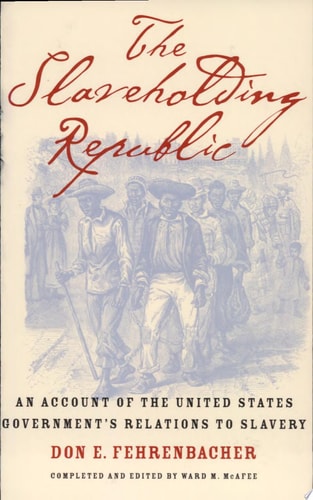
The Slaveholding Republic: An Account of the United States Government's Relations to Slavery
0
0
As an Amazon Associate and affiliate partner, Menrva Books earns from qualifying purchases. Learn more
Author Description
William Lloyd Garrison argued--and many leading historians have since agreed--that the Constitution of the United States was a proslavery document. Garrison called it "a covenant with death, and an agreement with hell." But in The Slaveholding Republic, one of America's most eminent historians, Don E. Fehrenbacher, argues against this claim, in a wide-ranging, landmark history that stretches from the Continental Congress to the Presidency of Abraham Lincoln. Fehrenbacher ranges from sharp-eyed analyses of the deal-making behind the "proslavery clauses" of the constitution, to colorful accounts of partisan debates in Congress and heated confrontations with Great Britain (for instance, over slaves taken off American ships and freed in British ports). He shows us that the Constitution itself was more or less neutral on the issue of slavery and that, in the antebellum period, the idea that the Constitution protected slavery was hotly debated (many Northerners would concede only that slavery was protected by state law, not by federal law). Nevertheless, he also reveals that US policy--whether in foreign courts, on the high seas, in federal territories, or even in the District of Columbia--was consistently proslavery. The book concludes with a brilliant portrait of Lincoln. Fehrenbacher makes clear why Lincoln's election was such a shock to the South and shows how Lincoln's approach to emancipation, which seems exceedingly cautious by modern standards, quickly evolved into a "Republican revolution" that ended the anomaly of the United States as a "slaveholding republic." The last and perhaps most important book by a Pulitzer-Prize winning historian, The Slaveholding Republic illuminates one of the most enduring issues in our nation's history.
Menrva's Summary
THE THESIS
This book investigates the central question of whether the United States Constitution was inherently a proslavery document or a neutral framework that was manipulated by federal policy. Don E. Fehrenbacher, a Pulitzer Prize-winning historian, utilizes extensive archival research and legislative records to challenge the long-standing Garrisonian interpretation of the Constitution. He argues that while the document itself remained neutral, the practical application of federal policy throughout the antebellum period consistently favored the interests of slaveholders. The work provides a comprehensive examination of how political, diplomatic, and legal mechanisms were employed to sustain the institution of slavery until the transformative presidency of Abraham Lincoln.
THE SCOPE MAP
What You Will Find
- Analysis of the constitutional debates and the specific clauses related to slavery during the founding era.
- Examination of diplomatic confrontations with Great Britain regarding the status of enslaved people on international waters.
- Detailed accounts of partisan legislative battles within Congress concerning federal territories and the District of Columbia.
- A historical assessment of Abraham Lincoln's political evolution from cautious policymaker to the leader of the Republican revolution.
THE AUTHORITY PERSPECTIVE
Experts and historians recognize this work as a definitive, scholarly examination of the intersection between constitutional law and the institution of slavery. Readers frequently note the dense, analytical nature of the prose, which serves as a foundational text for understanding the political complexities of the antebellum United States.
Page Count:
480
Publication Date:
2001-01-01
Publisher:
Oxford University Press
ISBN-10:
0198032471
ISBN-13:
9780198032472
Politics
History
Slavery
Americas
Kindle eBooks
Kindle Store
Constitutional Law
Specific Topics
Categories
United States
Slavery & Emancipation
Community Tags
Similar Books