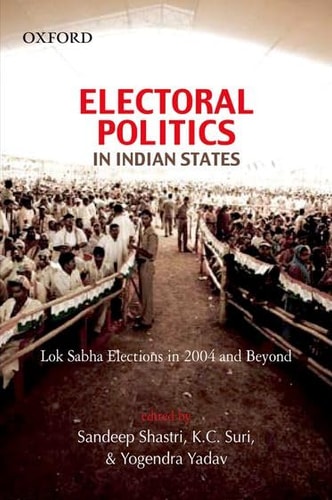
Electoral Politics in Indian States: Lok Sabha Elections in 2004 and Beyond
0
0
As an Amazon Associate and affiliate partner, Menrva Books earns from qualifying purchases. Learn more
Author Description
In the Fourteenth Lok Sabha Elections held in 2004, it was immediately apparent that the ruling coalition--the National Democratic Alliance (NDA)--had been voted out of power and its place taken by another coalition of political parties, the United Progressive Alliance (UPA). Despite thisseemingly clear verdict at the time, the mandate of the elections was largely unclear. Electoral Politics in Indian States: Lok Sabha Elections of 2004 and Beyond is a comprehensive analysis of the outcomes of the 2004 elections.Using detailed electoral data from the 2004 elections from across the country, the volume covers various states, including Andhra Pradesh, Karnataka, and Kerala from the south; Maharashtra, Goa, Gujarat, and Rajasthan from the west; Delhi, Haryana, Punjab, Jammu & Kashmir, Uttarakhand, and UttarPradesh in the north; and Jharkhand, West Bengal, Sikkim, Arunachal Pradesh, Mizoram, and Manipur in the east. It examines the phenomenon of the 'third electoral front', which came into being with the 1989 elections and continues till date. From its origins in a time of political and economicinstability and social upheaval, the front has, by this time, given way to a more stable order, even though the era of single party ruled governments has given way to coalition politics. The book highlights the role of state and regional politics at the center, and how the clout of regional partieshas increased over the last ten years.This timely and topical volume will be useful for researchers and students of Indian politics, as well as academics, analysts and psephologists, journalists, and the general informed reader interested in the functioning of the Indian political system.
Menrva's Summary
THE THESIS
This volume investigates the shifting dynamics of Indian national elections by analyzing the 2004 Lok Sabha results and the subsequent rise of coalition politics. The authors, all prominent scholars in the field of Indian political science, utilize extensive electoral data to argue that the 2004 mandate signaled a transition from the instability of the late 20th century to a more entrenched era of regional party influence. By examining state-level voting patterns, they provide a framework for understanding how regional political actors have fundamentally altered the governance of the Indian state.
THE SCOPE MAP
What You Will Find
- Detailed electoral data analysis covering major states across the northern, southern, eastern, and western regions of India.
- An examination of the 'third electoral front' and its evolution from the 1989 elections through the early 2000s.
- Comparative studies of state-level political trends and their direct impact on central coalition formation.
- Scholarly assessment of the decline of single-party dominance in favor of multi-party coalition governance.
THE AUTHORITY PERSPECTIVE
Experts and academics recognize this work as a foundational text for understanding the complexities of the Indian electoral system during a pivotal transitional period. Readers frequently note the density of the data provided, making it a primary resource for students and researchers of South Asian political systems.
Page Count:
453
Publication Date:
2009-12-15
Publisher:
Oxford University Press
ISBN-10:
0198063296
ISBN-13:
9780198063292
History
Elections
Government
India
Indian Politics
Community Tags
Similar Books