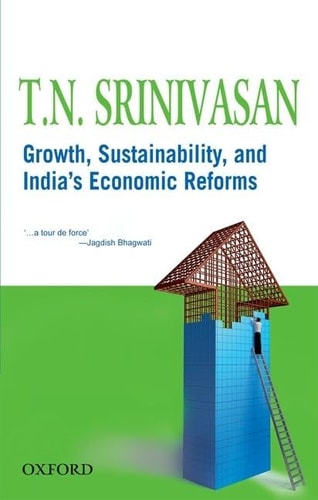
Growth, Sustainability, and India's Economic Reforms
0
0
As an Amazon Associate and affiliate partner, Menrva Books earns from qualifying purchases. Learn more
Author Description
This book analyses the origins, rationale, and outcomes of India's economic reforms of 1991 in the context of changes in economy, polity, and society. Using a historical and comparative perspective, the book provides a comprehensive review of the policies and performance of the Indian economy.The author categorizes India's development experience into four time periods and provides a comparative analysis across these: (i) 1950-80: conservative macroeconomic policies, slow growth, and a crisis in 1966; (ii) 1980s: piecemeal reforms, fiscal profligacy, accumulation of domestic and external private debt and faster growth, and the crisis of 1991; (iii) 1991-2009: systemic reforms and growth acceleration; and (iv) 2009-11: the global financial crisis. He also compares the Indian experience with the growth and development strategies of China and certain low-income countries. Drawing lessons from economic theory to understand the policy problems faced by India, the book examines the implications of the recent global financial crisis on growth, sustainability, and the necessity for further reform. The intrinsic objective of India's development-the eradication of mass poverty-and the instruments for achieving it such as acceleration of growth, industrialization, accumulation of physical and human capital, and improvement in productivity are highlighted.
Menrva's Summary
THE THESIS
This book investigates the efficacy and long-term sustainability of India's economic development strategies following the systemic reforms initiated in 1991. T. N. Srinivasan, a distinguished economist, utilizes a rigorous historical and comparative framework to evaluate India's policy shifts across four distinct developmental eras. By synthesizing economic theory with empirical performance data, the author argues that sustained growth and poverty eradication require continued structural reform and strategic capital accumulation.
THE SCOPE MAP
What You Will Find
- A longitudinal analysis of India's economic policy from 1950 through 2011.
- Comparative studies contrasting Indian development strategies with those of China and other low-income nations.
- A detailed examination of the 1991 economic crisis and the subsequent systemic reforms.
- Theoretical frameworks addressing the impact of global financial crises on domestic growth and sustainability.
THE AUTHORITY PERSPECTIVE
Experts recognize this work as a foundational text for understanding the evolution of the Indian economy through the lens of institutional reform. Readers frequently note the academic density of the prose, which provides a comprehensive and technical overview suitable for students and policy analysts alike.
Page Count:
120
Publication Date:
2011-11-10
Publisher:
Oxford University Press
ISBN-10:
019807638X
ISBN-13:
9780198076384
Economics
History
Public Policy
India
Kindle Store
Kindle eBooks
Categories
Development