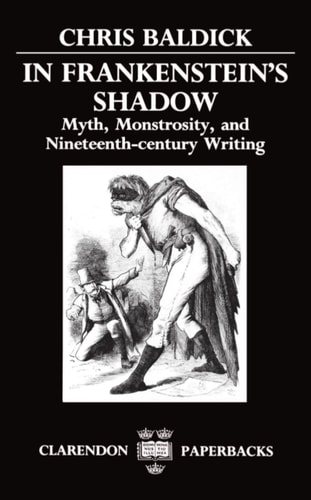
In Frankenstein's Shadow: Myth, Monstrosity, and Nineteenth-Century Writing
0
0
As an Amazon Associate and affiliate partner, Menrva Books earns from qualifying purchases. Learn more
Author Description
The story of Frankenstein and the monster he created is one of our most important modern myths. This study surveys the history of the myth in literature before the advent of film. First examining the range of meanings generated by Mary Shelley's Frankenstein in light of images of political "monstrosity" produced by the French Revolution, Baldick goes on to trace the protean transformations of the myth in the fiction of Hoffmann, Hawthorne, Dickens, Melville, Conrad, and Lawrence, as well as in the historical and political writings of Carlyle and Marx and the science fiction of Stevenson and Wells. In conclusion, he shows that the myth's most powerful associations have centered on human relationships, the family, work, and politics.
Menrva's Summary
THE THESIS
This study investigates how the myth of Frankenstein evolved from Mary Shelley's original text into a pervasive cultural symbol of monstrosity throughout the nineteenth century. Chris Baldick, a scholar of English literature, utilizes a historical and comparative framework to analyze how various writers adapted the creature metaphor to address anxieties regarding politics, industrialization, and social alienation. By examining primary texts from the Romantic era through the late Victorian period, the author argues that the myth functions as a flexible vessel for expressing complex human concerns about family, labor, and governance.
THE SCOPE MAP
What You Will Find
- Analysis of the French Revolution's influence on early depictions of political monstrosity.
- Comparative literary studies of authors including Hoffmann, Hawthorne, Dickens, Melville, Conrad, and Lawrence.
- Examination of the myth's presence in the political writings of Carlyle and Marx.
- Exploration of scientific and social themes within the works of Stevenson and Wells.
THE AUTHORITY PERSPECTIVE
Scholars and critics frequently cite this work as a foundational text for understanding the literary lineage of the Frankenstein myth before its cinematic popularization. Readers often note the academic rigor and the depth of the author's synthesis of political and social history with literary analysis.
Page Count:
224
Publication Date:
1988-02-11
Publisher:
Oxford University Press
ISBN-10:
0198117264
ISBN-13:
9780198117261
History
Nineteenth century
Mythology
Literary Criticism