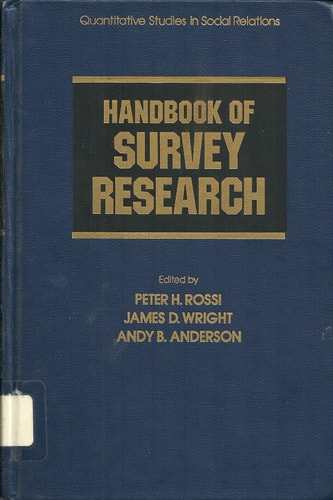
Handbook of Survey Research
0
0
As an Amazon Associate and affiliate partner, Menrva Books earns from qualifying purchases. Learn more
Author Description
This volume is a comprehensive guide to the major components of survey research design and data analysis. State-of-the-art essays by acknowledged authorities in the field outline the techniques and practical applications of every aspect of survey research. The thorough presentation and up-to-date bibliographies make this an invaluable handbook for the practitioner and student. From the Preface We had four main goals in writing this book: 1. To clarify and develop models and methods for causal analysis of dynamic social processes. 2. To formulate continuous-time models of change in both quantitative and qualitative outcomes and to develop suitable methods for estimating these models from the kinds of data commonly available to sociologists. 3. To develop a stochastic framework for analyzing both qualitative and quantitative outcomes. 4. To altere the way that sociologists think about the empirical study of social change processes. This book is divided into three parts. Part I provides a general background for what follows; it includes both a discussion of the substantive importance of dynamic analyses is sociology and a review of models and methods previously used by sociologists interested in the empirical study of social dynamics. Part II contains eight chapters on models and methods for analyzing change in qualitative outcomes; it concentrates mainly on methods based on analyses of event-history data. Part III contains six chapters on comparable models and methods for analyzing change in quantitative outcomes; it focuses primarily on methods based on analysis of panel data.
Menrva's Summary
THE THESIS
This handbook addresses the fundamental components of survey research design and data analysis, aiming to advance the empirical study of social change processes. The authors, recognized authorities in their fields, present state-of-the-art essays detailing the techniques and practical applications across all facets of survey research. The book is structured into three parts: Part I offers a general background on the substantive importance of dynamic analyses in sociology and reviews prior models and methods. Part II focuses on analyzing change in qualitative outcomes, primarily using event-history data, while Part III covers comparable models and methods for quantitative outcomes, concentrating on panel data analysis.
THE SCOPE MAP
- Models and methods for causal analysis of dynamic social processes.
- Continuous-time models for change in quantitative and qualitative outcomes.
- Methods for estimating models from commonly available sociological data.
- A stochastic framework for analyzing both qualitative and quantitative outcomes.
- Analysis of change in qualitative outcomes using event-history data.
- Analysis of change in quantitative outcomes using panel data.
THE AUTHORITY PERSPECTIVE
This volume is presented as an invaluable handbook for both practitioners and students of survey research, offering thorough presentation and up-to-date bibliographies. The authors' stated goals indicate a significant contribution to how sociologists approach the empirical study of social change. The structure, divided into foundational background, qualitative outcome analysis, and quantitative outcome analysis, suggests a comprehensive and systematic approach to the subject matter. The focus on advanced modeling techniques for dynamic social processes points to a text aimed at researchers seeking to deepen their analytical capabilities.
Page Count:
755
Publication Date:
1983-01-01
Publisher:
Academic Press
ISBN-10:
0125982267
ISBN-13:
9780125982269
Science
Non-Fiction
Sociology
Statistics
Research Methods
Data Analysis
Community Tags
Similar Books