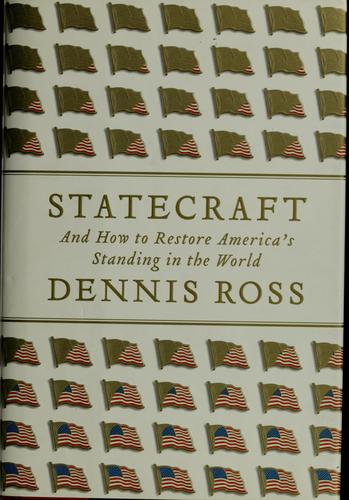
Statecraft
0
0
As an Amazon Associate and affiliate partner, Menrva Books earns from qualifying purchases. Learn more
Author Description
Not long after 9/11 brought the free world to our side, U.S. foreign policy is in a shambles. Here, peace negotiator Dennis Ross argues that the Bush administration's problems stem from its inability to use the tools of statecraft--diplomatic, economic, and military--to advance our interests. Statecraft is as old as politics: Plato wrote about it, Machiavelli practiced it. After the demise of Communism, some predicted that statecraft would wither away. But Ross explains that in the globalized world--with its fluid borders, terrorist networks, and violent unrest--statecraft is necessary simply to keep the peace. He outlines how statecraft helped shape a new world order after 1989. He shows how the failure of statecraft in Iraq and the Middle East has undercut the United States internationally, and makes clear that only statecraft can check the rise of China and the danger of a nuclear Iran.--From publisher description.
Menrva's Summary
THE THESIS
Statecraft is essential for maintaining peace and advancing national interests in a complex, globalized world. Dennis Ross, a seasoned peace negotiator, argues that the Bush administration's foreign policy failures stem from an inability to effectively employ diplomatic, economic, and military tools. He posits that statecraft, a practice as old as politics itself, remains crucial for navigating fluid borders, terrorist networks, and global unrest. The book examines how statecraft shaped the post-1989 world order and analyzes its recent failures in Iraq and the Middle East, which have weakened the United States internationally.
THE SCOPE MAP
- What You Will Find:
- Analysis of the Bush administration's foreign policy challenges post-9/11.
- Historical examples of statecraft from Plato to Machiavelli.
- The role of statecraft in shaping the post-1989 world order.
- Case studies on the failures of statecraft in Iraq and the Middle East.
- Assessment of the challenges posed by China and Iran.
- Arguments for the necessity of diplomatic, economic, and military tools in foreign policy.
THE AUTHORITY PERSPECTIVE
Dennis Ross's 'Statecraft' is presented as a critical examination of contemporary U.S. foreign policy, drawing on his extensive experience as a peace negotiator. The book argues for the enduring necessity of traditional statecraft in a world marked by globalization and instability. It analyzes specific geopolitical challenges, including the situations in Iraq, the Middle East, and the rise of China and nuclear Iran, suggesting that effective use of diplomatic, economic, and military tools is paramount for national interests and global peace. The publisher description frames the work as a timely intervention, highlighting its relevance to ongoing international relations debates.
Page Count:
370
Publication Date:
2007-01-01
ISBN-10:
0374299285
ISBN-13:
9780374299286
Non-Fiction
Politics
Science
International relations
Foreign Policy
Geopolitics
Community Tags
Similar Books