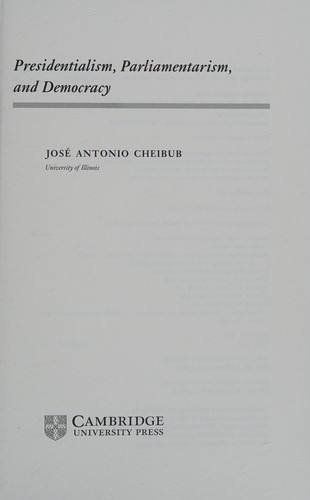
Presidentialism, Parliamentarism, and Democracy
0
0
As an Amazon Associate and affiliate partner, Menrva Books earns from qualifying purchases. Learn more
Author Description
Are newly established presidential democracies doomed to fail? In support of their positive answer to this question, advocates of parliamentarism point out that these regimes tend to last longer than presidential ones. This book takes a contrary view. It argues that most of the reasons offered for the poor survival record of presidential democracies - that they are prone to deadlocks, offer no incentives for coalition formation, make political parties weak, and fragment decision making - have neither sound theoretical foundations nor any empirical support. In fact, what has made presidential democracies more fragile is that they typically emerged in countries where the military was already strong, which placed democracy of any kind at risk. Therefore, the prospects of new democracies that have established a directly elected president as their head of government may be better than usually considered. Instead of attempting to change the form of government, institutional reformers should thus concentrate on designing a better presidential democracy.--Jacket.
Menrva's Summary
THE THESIS
Presidential democracies are not inherently doomed to fail, despite their commonly perceived fragility. The book challenges the prevailing view that presidential systems are prone to failure, arguing that the reasons cited for their poor survival rates—such as deadlocks, lack of coalition incentives, weak parties, and fragmented decision-making—lack theoretical and empirical support. Instead, it posits that the military's strength in countries where presidential democracies typically emerge is the primary threat to democratic stability. Therefore, institutional reformers should focus on improving existing presidential democracies rather than advocating for a shift to parliamentary systems.
THE SCOPE MAP
- What You Will Find:
- Analysis of the survival rates of presidential versus parliamentary democracies.
- Critique of common theoretical and empirical arguments against presidentialism.
- Examination of the role of military strength in the stability of new democracies.
- Argument for institutional reform within presidential systems.
- Comparative analysis of democratic regime types.
THE AUTHORITY PERSPECTIVE
The book challenges conventional wisdom regarding the stability of presidential democracies, offering a counter-argument to the notion that they are inherently fragile. It suggests that external factors, particularly the influence of the military, play a more significant role in democratic survival than the institutional design itself. The work advocates for a focus on improving presidential systems rather than replacing them, proposing that new democracies with directly elected presidents may have better prospects than commonly assumed.
Page Count:
202
Publication Date:
2007-01-01
ISBN-10:
0521834678
ISBN-13:
9780521834674
Non-Fiction
Politics
Democracy
Comparative Politics
Community Tags
Similar Books