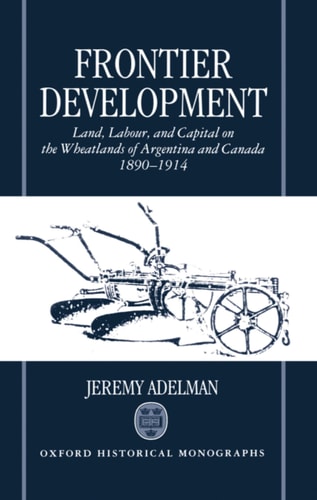
Frontier Development: Land, Labour, and Capital on the Wheatlands of Argentina and Canada, 1890-1914
0
0
As an Amazon Associate and affiliate partner, Menrva Books earns from qualifying purchases. Learn more
Author Description
This is the most comprehensive comparative study of the agrarian systems of the frontier lands of Argentina and Canada in the late nineteenth and early twentieth centuries. Jeremy Adelman challenges much received wisdom about the economic "success" of North America and the "failure" of Latin America. Based on extensive primary research in Argentina, Canada, and Britain, Adelman's book points to the central importance of property relations in economic history in these regions.
Menrva's Summary
THE THESIS
This work investigates the divergent economic trajectories of the Argentine and Canadian wheat frontiers between 1890 and 1914 to determine how property relations influenced regional development. Jeremy Adelman, a scholar of economic history, utilizes extensive archival research from Argentina, Canada, and Britain to construct a comparative framework. He challenges traditional narratives that attribute the economic success of North America and the relative stagnation of Latin America to simple cultural or geographic factors, arguing instead that the specific legal and social structures governing land, labor, and capital were the primary determinants of growth.
THE SCOPE MAP
What You Will Find
- Comparative analysis of agrarian systems in the Canadian Prairies and the Argentine Pampas.
- Examination of property rights, land tenure systems, and labor market organization.
- Primary source data derived from government records, land registries, and economic reports.
- Analysis of the role of international capital flows in shaping frontier development.
THE AUTHORITY PERSPECTIVE
Historians and economists recognize this monograph as a foundational text for understanding the institutional differences between settler societies in the Americas. Readers frequently note the academic density of the prose and the rigorous nature of the comparative methodology employed.
Page Count:
344
Publication Date:
1994-09-08
Publisher:
Clarendon Press
ISBN-10:
0198204418
ISBN-13:
9780198204411
History
Wheat Trade
Capital_canada
Comparative History
Labor_canada
Economic History
Canadian History
Land Use






![Great ideas in economics ([Great ideas series, no. 5])](https://storage.googleapis.com/menrva_img_storage/covers/9780080070636.jpg)