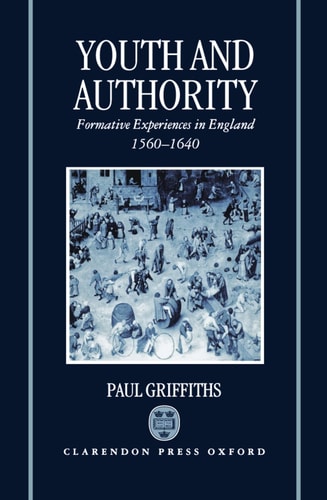
Youth and Authority: Formative Experiences in England 1560-1640
0
0
As an Amazon Associate and affiliate partner, Menrva Books earns from qualifying purchases. Learn more
Author Description
In this new work, Paul Griffiths surveys the attitudes and activities of young people, examining their reaction to authority and to society's concept of the `ideal place' for them in the social order. He sheds new light on issues as diverse as juvenile delinquency, masculinity, sexual behavior and courtship, clothing, catechizing, office-holding, and church seating plans. His research reveals much about the nature of youth culture, religious commitment, and master/servant relations, and leads to the identification of a separate milieu of `masterless' young people.
Menrva's Summary
THE THESIS
This work investigates how young people in early modern England navigated the tension between their own developing identities and the rigid expectations imposed by social and religious authorities. Paul Griffiths, a scholar of early modern social history, utilizes a wide array of archival records to reconstruct the daily lives of youth between 1560 and 1640. He argues that young people were not merely passive subjects of adult control but active participants in shaping their own subcultures, often operating outside the traditional structures of the household and the church.
THE SCOPE MAP
What You Will Find
- Analysis of juvenile delinquency and social deviance in the late sixteenth and early seventeenth centuries.
- Examination of gendered expectations, specifically regarding masculinity and courtship rituals.
- Investigation into the master-servant relationship and the emergence of a 'masterless' youth demographic.
- Study of institutional control mechanisms including catechizing, clothing regulations, and church seating arrangements.
THE AUTHORITY PERSPECTIVE
Historians and sociologists frequently cite this text as a foundational study for understanding the social construction of youth in the pre-industrial era. Scholars note the depth of the archival research, which effectively challenges previous assumptions about the passivity of young people in early modern society.
Page Count:
472
Publication Date:
1996-05-23
Publisher:
Clarendon Press
ISBN-10:
0198204752
ISBN-13:
9780198204756
History
Social History
Sociology
Youth Studies
Authority
Great Britain
Community Tags
Similar Books