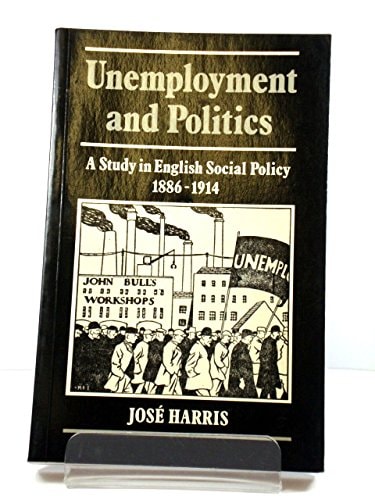
Unemployment and Politics: A Study in English Social Policy, 1886-1914
0
0
As an Amazon Associate and affiliate partner, Menrva Books earns from qualifying purchases. Learn more
Author Description
This book examines the development of English social policy towards the unemployed between 1886 and 1914. It traces the shift from the Victorian emphasis on individual responsibility and private charity to the Edwardian acceptance of state intervention, culminating in the National Insurance Act of 1911. Jose Harris analyzes the political, economic, and social factors that influenced this change, providing a detailed study of the debates and policies that shaped the modern welfare state.
Menrva's Summary
THE THESIS
This study investigates the complex relationship between rising unemployment and the evolution of English social policy during the late Victorian and Edwardian eras. Jose Harris, a distinguished historian of social policy, utilizes extensive archival research and parliamentary records to examine how political ideologies and economic theories shaped the government's response to labor market instability. The work argues that the period between 1886 and 1914 served as a critical transition point where traditional laissez-faire attitudes gave way to the early foundations of the modern welfare state.
THE SCOPE MAP
What You Will Find
- Analysis of the transition from private charity to state-sponsored social intervention.
- Examination of the influence of the Royal Commission on the Poor Laws.
- Use of primary source documents including government reports, political correspondence, and contemporary economic treatises.
- Detailed exploration of the political debates surrounding the Unemployed Workmen Act of 1905.
THE AUTHORITY PERSPECTIVE
Historians and political scientists frequently cite this work as a foundational text for understanding the origins of British social legislation. Readers often note the academic density of the prose, which provides a rigorous and comprehensive account of the period's policy shifts.
Page Count:
411
Publication Date:
1984-10-18
Publisher:
Oxford University Press
ISBN-10:
0198200722
ISBN-13:
9780198200727
History
Economics
Great Britain
British History
Social policy
Labor Policy
Unemployment